
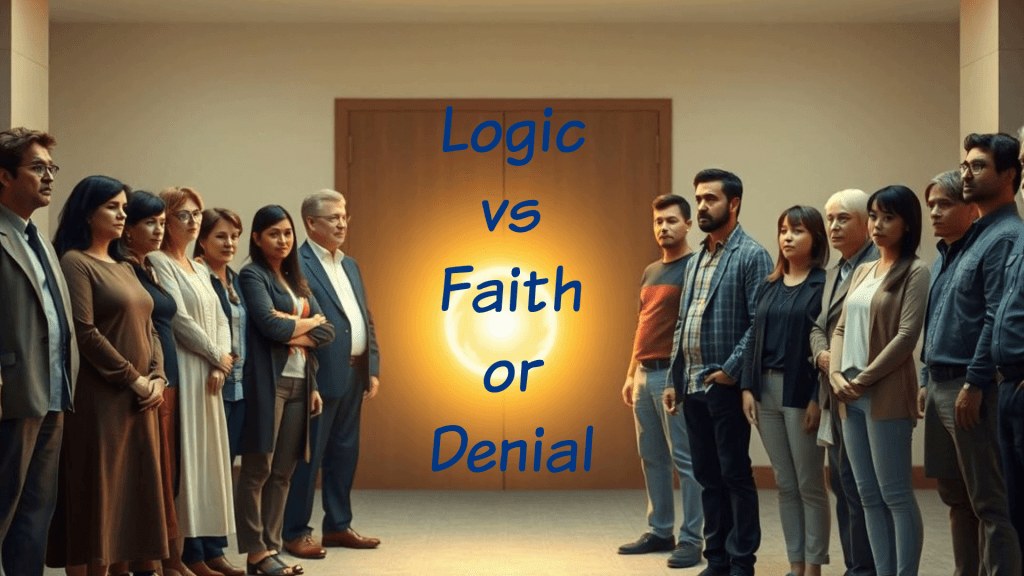
They say ignorance is bliss, but it is really comfort we crave. The truth that defies expectation is typically seen as an intrusion, which can make us feel uncomfortable. That is the ugly side of learning. In order to learn anything new, we all had to accept what we thought would be true wasn’t.
Pardon the Intrusion
Very few subjects allow us to escape the discomfort of reality dismantling the world we once imagined. For many of us, the introduction to God or idea of creator provided a safe haven for our inner children. No matter how certain we are on any aspect of creation, there will always be enough gaps in knowledge where anything is possible. Whether you’re religious, atheist, or somewhere in between; whatever you believe about God is hinged on the belief that no proof is possible, one way or the other.
When someone like me comes along with logic and math that make those gaps irrelevant, it can feel like a personal intrusion. It’s not meant to be. But I understand—it can feel like I’m trespassing in a very private space. Since it threatens the sanctuary that protects our inner child, I must be the villain of your story. It is impossible for me to avoid being an intruder, but it should be seen as a pleasant surprise instead of a reason to get defensive.
No New Math Here
The interesting thing is: I don’t offer any new information to make my point. The concept I use has been known for centuries. It’s so basic, we learn it as children when we are first introduced to algebra.
I use the analogy God is to reality what zero is to math to highlight how zero’s role as the foundational reference point to define all numbers and prove all equations mirrors God’s role in reality. It removes the personified, imagined layers we often associate with God, replacing them with something simpler: a necessary origin. That makes it harder to reject—yet harder to picture.
The same logic we apply to everything else must apply to what we should believe about God. Math is our most objective way of describing reality. Zero is the absolute foundation for math, so why exclude zero from math’s application to reality? The reality that would correspond to zero as used as the foundational reference point to define all numbers and prove all equations would be what we would call the creator of all, universal origin, or infinite singularity.
Accept the Reasonable, Even Though It’s Unimaginable
The only objection would be a lack of tangible proof, but it is unreasonable to deny the existence of the necessary because we can’t prove the absence of what we can’t exist without or even imagine reality without. By definition, zero is none of what can be witnessed or measured.
We define zero according to what it isn’t, but it should be described according to its relation to all else. Some will try to point to zero as having no value in an attempt to dismiss and demean. I will point to zero being invaluable as a reason to exalt and praise.
Any attempt to imagine the reality zero must represent will defeat the purpose of the comparison. The whole point is there is enough evidence in what we can witness and perceive that points to an origin we cannot even imagine. True faith isn’t rejecting logic and reason in order to accept things that don’t make sense. It should be accepting what makes sense even though you cannot imagine it.
Explore the Known About the Unseen
Intellectual Righteousness is an invitation to leave the supernatural for the logical in our search for God. You don’t have to reject your sense of wonder. You just have to stop outsourcing it to fantasy.
Explore what zero means to math as a foundational reference point and you will discover what we have reason to believe about God. If there’s a debate left, it’s the one between your comfort and your clarity. You already know the truth. The only question is: are you ready to face it?
Leave a Reply