
The Analogy Breakdown
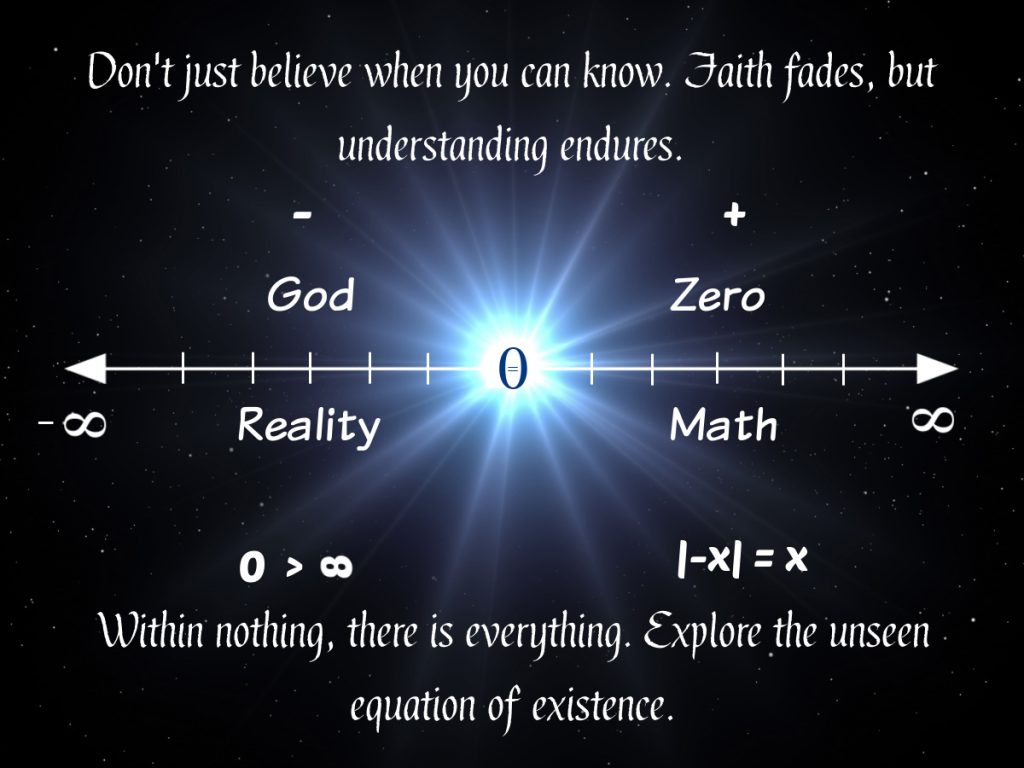
God is to reality what zero is to math is an analogy that can help define and describe God. It is so far from what people expect, that it can be easily misunderstood when it gets introduced. Let’s try to minimize the chance for confusion by defining each key word in order to make the meaning of the analogy clearer.
Of course, God and zero don’t seem like they are comparable. God is supreme and zero is just an insignificant placeholder. That is the reason behind using an analogy in the first place. God isn’t zero, and zero isn’t God. An analogy is a comparison between two otherwise unlike things based on similarity in a particular aspect. Usually, an idea or concept we are clear and certain about is used to explain something harder to grasp.
Since the analogy is meant to help define the word “God”, we will replace it with an “x” for unknown. Avoiding that word may keep people from being triggered into getting defensive, as well. For now, we are saying there is something in reality that is like zero in math.
Reality and Math
Please, don’t misinterpret that statement into “x is to reality what zero is to reality”. Zero in reality is an emptiness or lack, but math isn’t reality itself. It is our most accurate and objective way of describing reality.
Just because we invented the sounds and symbols for math doesn’t mean we invented the rules and values within it. In order for something to be true in math, it must relate to or describe something real.
Some advanced or untested mathematical ideas may not apply to the real world. We won’t be dealing with any of them. We will be sticking to the basics. If you understand the fundamental principles of algebra, this will not be too advanced at all. If you have learned more advanced math, none of it will be relevant to this conversation. This will not be an exercise to determine who knows more about math.
Reality is what it is whether we observe it or not. Its attributes do not depend on how we measure or understand them. Math is the science of objectively describing and understanding quantity and patterns in reality. Numbers themselves act as a shorthand for adjectives answering the question “how many” or “how much?”. They are not real, but they are only relevant or useful because they effectively describe what is real.
Zero in Math
Unlike adjectives or any other words, which are defined by agreement and added to a dictionary or glossary; numbers are defined by their relation to zero. In order for there to be a first of anything, there must have previously been none; no exceptions. The reason why numerical values are objectively consistent is because they are defined in relation to something constant, unchanging, and unable to be defined in finite terms: zero.
Because zero was discovered long after the invention of various numerical systems, it is easy to assume we don’t actually need it to define numbers. History is much like our personal learning experiences. We learn about numbers through example and are able to perform basic arithmetic without concern for zero as an absolute value. Upon its discovery, we find we have been implicitly using it all along without realizing it.
Whenever you clear up some empty space to start counting, that empty space represents zero. The unmarked edge of a ruler or measuring tape is zero. When you slide all the pegs of an abacus to one side, that signifies zero. When you close your fist in order to begin counting with your fingers, that is zero.
Zero is not a human construct. It is the unavoidable starting point for all measurable values. We do not impose zero onto systems. We recognize its necessity within them.
Despite being the foundational reference point for defining all numbers and proving all equations, many people assume zero has no connection to reality. Since zero has no finite attributes, it’s impossible to provide finite evidence for it. Seeking tangible or sensory proof for the reality zero represents is an unreasonable request.
What would be even more unreasonable is assuming that our most objective system for describing reality is built on a fictional foundation. Even if zero were just a mathematical invention, we wouldn’t have needed to invent it unless there was something real it described. Wouldn’t what zero describes be the foundational reference for reality itself?
The Reality Only Zero Can Describe
Since measurement must begin with a first, and there must have previously been none for a first to exist, the only logical conclusion is that anything measurable must have an origin that is immeasurable. Confusing potential infinity with something that has no beginning or end and misapplying of the law of conservation of matter and energy can cause people to resist this undeniable truth.
Potential infinity is considered limitless because we are unable to determine its boundaries. From our perspective, certain things can go on forever without end, such as: space and time. We need them in order to exist, so it is impossible to have a vantage point to even contemplate or imagine reality without them. It is illogical to impose our limits in cognition on reality itself.
The law of conservation states that neither matter nor energy can create or destroy themselves or each other, yet some mistakenly use it as proof that they are eternal. Because our existence and perception depends on matter and energy, it’s easy to overlook the contradiction in assuming measurable things have no beginning. The law of conservation should be used as evidence that matter and energy needs an origin that is neither material or active.
It is impossible for something to be both infinite and finite. The infinite cannot be defined or described in finite terms. If your idea of infinity includes finite aspects, there is a flaw in your logic. Whatever can be defined or described in finite terms is finite throughout. Since it is impossible to act prior to existence and measurement must begin somewhere, the finite must have an infinite origin.
Only zero, as shown on the number line, can mathematically represent an infinite origin. It is the starting point for all measurement and the reference for defining all values in math. Since it has no finite attributes, it has no beginning or end. Our inability to produce finite evidence for zero and the origin is the sole reason for denying their existence.
Why God
Everything that’s universally believed about God matches the reality zero in math must represent, except the things that allow for imagination or personification. The God analogy not only gives us an example of something we understand yet cannot perceive or imagine, but it also strips away all the contradictions associated with defining or describing the creator in ways that only fit creation.
Our power comes from choice and actions, so it is extremely difficult to think of dominion or supremacy without them. A deity we can relate to would make us more comfortable. Unfortunately, that comfort leads to contradictions. Our morals and virtues cannot be separated from our flaws and limitations, and what may be meant as a compliment is demeaning and insulting.
People who prefer a more personal approach to God may have issues with this comparison. “If God doesn’t care or isn’t active, why worship ‘Him’?” This type of question downgrades the absolute creator of all to a genie that grants wishes or a Santa Claus for adults that gives heaven to nice and hell to the naughty.
The lack of perception, imagination, or personification of God may make it seem like there is no way to understand or describe God. Zero’s role as the foundational reference for all value in math gives us more insight than what is assumed. Zero represents the absolute, infinite, perfect, eternal, and omnipresent. The law of identity shows that the origin must be omniscient and omnipotent without intellect or action. Some people mention zero has no value in an attempt to demean and dismiss. I see it as invaluable, which would be reason to exalt and praise.
God is to reality what zero is to math. Zero is the foundational reference point for math, and math describes reality. The foundation of reality must be singular, supreme, and worthy of the highest esteem—what we call God. Even if you have difficulty separating the word “God” from the myths and personified attributes that have been linked throughout history, the analogy shows those fictional ideas are based on something real, much like how Santa Claus is based on Saint Nicholas of Myra.
Explore what zero as illustrated on the number line means to math academically and you will gain a deeper understanding of God and the meaning of life. We all learned and accepted zero’s role in math, whether to fully understand it or simply to pass, so no new information about its properties is needed here.
The truth does not depend on belief or personal preference. It remains true, regardless of whether it is accepted, ignored, or misunderstood. There is no reason to focus on our gaps in knowledge or believe they open the door for fabrication. Just because we don’t understand everything doesn’t mean we should doubt what we already know.