

Video Coming Soon
The Greatest Religious Miracle is an hour-long presentation of Intellectual Righteousness that uses math to give logical proof for God and features some light humor, self-introspection, and musical interludes. It is currently in production. Read the script (below) or explore one of our other feature articles as we finish producing the Greatest Religious Miracle.
Featured Articles:
Does God Exist?: That depends on what you mean by God.
The Best Argument for God: The foundation of math can be used to prove the existence of the foundation of reality.
The Analogy vs Atheism: If logic is your standard of proof, follow it all the way.
What is There to Argue About?: The debate about God has raged for centuries. Let’s get to the root.
Embrace Certainty: Faith wasn’t good enough. Neither was doubt or disbelief. Try a third option, logic.
Let’s Get Nerdy About God: Education is pointless when it gets used to deny what is logically sound.
Zero and the Attributes of God: Here is how the classic descriptions of God apply to zero.
Hello World
Before I begin, I would like to thank God for giving me the insight to notice the connection between God and the foundational reference point of math, the integrity to accept it even though it seemed like blasphemy at first, and the perseverance to continue trying to share this message, what I call the greatest religious miracle, even though experience has taught me people don’t really want to have any certainty about God.
I would also like to thank you for taking the time to explore how understanding the connection helps us understand God and all that it includes. I hope to be worthy of your attention. Allow me to introduce myself: Hello world. I am Hassan Bfly, the self-taught, non-prophet messenger of God.
That feels weird to say, messenger of God. I almost cringe whenever I say it out loud, so I can imagine your reaction. It sounds arrogant and boastful. Kind of, but not really. I’m trying to thread the needle of hyping myself up without exaggerating or overestimating myself. I have to hype myself up to myself because bringing logic to a faith fight can be frustrating, and presenting yourself as having any religious expertise without extensive study or any supernatural source of information is intimidating. I have to hype myself to you because if I have no expertise, why listen?
I call myself messenger because what I have to say is special, not because I’m special. While I don’t find anything about myself particularly interesting, the connection between God and zero can be as impactful to monotheism as the introduction of monotheism was to theism itself
The Message
When I say monotheism, I don’t just mean the idea of only one god. I mean the idea that only the Creator of all is worthy of worship. That is the message. There is no way to perceive or imagine the Creator, so it is easy for followers to drift away from the truth while trying to describe God.
Imagining the unseen and personifying the supreme are natural tendencies that are difficult to resist. It may not be apparent that they should be resisted because the urge to follow them is so automatic. Just the attempt itself introduces a contradiction to the whole idea of a Creator. No matter how unique, the Creator would not fit into what they created. Any conclusions drawn within such a framework, no matter the intent, would be a contradiction that corrupts the message.
Each messenger in the past came to clean things up as much as the comprehension of their time would allow, following centuries of religious leaders compounding confusion by defending those contradictions. I thought the fact that we are taught the importance of zero as children when we learn about absolute value would make this easy for me, and I wouldn’t be much of a factor once the scholars and the intellectuals got introduced to the analogy: God is to reality what zero is to math.
After I made my breakthrough discovery, it became clear to me that the analogy sums up what those in the past were trying to say to people who did not understand zero’s role in math. Had they been ahead of their time when it comes to zero, they would have highlighted none for the sake of clarity.
Even though you understand zero, if I were to try to explain the reality zero holds a place for within math without referring to zero or none, you wouldn’t think of zero in math in order to conceptualize what I’m talking about. To hear about an origin that has no beginning and no end that is beyond our limited understanding and description would lead to imagining some sort of larger than life being with perfect intelligence and morals.
I’m sure such a tendency would have been much more likely for people that were born prior to the discovery of algebra. Here we are today arguing over who did better magic tricks and parsing over every word looking for deeper meanings when the over-arching message all of us should be getting is: ONLY THE CREATOR OF ALL IS WORTHY OF WORSHIP. Let’s focus on that.
My contribution is pointing out what we already understand about zero’s necessary role within math can give us logical certainty of a Creator with no finite attributes and a method of description that avoids personification and imagination, so it doesn’t lead to contradiction.
The logical certainty and ability to describe God without contradiction is the greatest religious miracle. Making the connection between God and zero can have a major impact on your life and the theological debate overall. The impact can be big enough to make this the latest installment of the same old message. I think my being the one pointing it out is akin to delivering a message that I didn’t necessarily write. Thus, messenger of God.
Non-Prophetic

One of the biggest problems with gassing myself up and calling myself a messenger of God is people start expecting me to do some sort of magic tricks to prove myself. Here I am thinking a messenger is defined by their message. I start talking about the connection between God and zero, and people will look at me like, “What are you doing? Where are your miracles?”
I don’t get it because how would being able to perform real magic prove what I say about God is correct? If you are someone who believes magic is real or can be more than just illusions, does its existence necessarily mean a real magician is godly? I present Intellectual Righteousness to you as the greatest religious miracle because even those who believe in miraculous events think a logically sound understanding of God is impossible. I would argue that many people who believe in the fantastic are willing to do so because of how impossible they think it is to logically understand God.
I call myself non-prophetic so people will know I don’t claim to have any magical gifts, ability to see into the future, and I haven’t been sent by anyone. I’m just a dude who realized the number that makes math reliable can be used to understand the reality that makes the universe possible. The proof of my validity is your ability to reason.
Who else do you know that would invite scrutiny as a means of confirmation? To be clear, I don’t need your acceptance for validation. Nothing I will say can compel you to change your mind. You can still ignore, dismiss, deflect, misinterpret, or focus on me to avoid admitting change is required. I say I can logically prove God is real because you cannot find a flaw in my information or reasoning. Any attempt will end in at least one logical fallacy.
I expect and respect your resistance. I just ask that you make an unbiased and objective assessment on what is right. If, by your own reasoning, you see that what I’m saying about God is consistent with itself and everything else we can prove, you will have to make a choice. You can either get mad because you lost a fight when you were proven wrong, or you can be glad that you learned a lesson when you were shown what is right.
Self-Taught

It would be cool if I had some supernatural source of information. I don’t really see how it would help or prove anything, though. Either way, people will believe I’m crazy for thinking I noticed something the experts and intellectuals overlooked, but a captivating story would beat reminiscing about math class. Even something like an Indiana Jones story where I unearthed some ancient tablet that translated to God is to reality what zero is to math would be attention-grabbing.
Personally, I think supernatural inspiration is overrated. I get irritated whenever people call the old books the word of God. Don’t get me wrong. I trust that those who claimed divine inspiration were sincere, but all we can ever hear or read are the words they wrote or said. Even if they are direct quotes, they are still the words of men. What is the proof that those words had a divine or supernatural source? There must be something behind those words to convince us they are godly besides a claim.
God is not the author of confusion, so what was said back then made sense to the people alive back then. Today, we can witness how things make so much sense that we are able to use math and sciences to accurately explain what we can perceive. The truth about God should make sense in a similar way. Ironically, the greatest religious miracle leaves no need for the supernatural.
When we look at God’s “handy work”, we see structure, order, and opportunity for logical application. It doesn’t make sense for us to throw all that context away when contemplating God directly. There is a big difference between something being beyond our comprehension and something going against what we can comprehend. Yes. It is possible for our reasoning to leave questions about God unanswered, but the answers we gather shouldn’t go against what we are able to learn.
I’m not hating on anyone from the past or making excuses for not having any magical powers. I’m just saying the accuracy and validity of the message being delivered is the proof if a messenger is legit. I know an awe-inspiring show or a good story is more entertaining than a discussion about God combined with math. God and math just sounds like a boring combination.
I can see the eyelids getting heavy and hear the snores now. Before you sleep on me, allow me the opportunity to logically prove God is real but different from expectation, describe God without imagination or personification, and show why knowing and accepting the truth improves life’s appreciation.
If you think right and wrong answers about God are impossible, this isn’t for you. If you can’t change your mind when new information you can’t logically refute is presented to you, there is probably no need to proceed.
But if you’re tired of having to choose between things that don’t exist in order to believe in God and be a good person or rejecting God altogether in order to feel reasonable, you should list. And listen carefully. Who am I? I’m Hassan Bfly, the self-taught, non-prophetic messenger of God.
The Search for God
When I started studying religion as an adult, one of my first thoughts was, “Man! It sure would be nice if we could draw rational conclusions about God instead of relying on blind faith. We have no way to tell who is telling the truth without them.”
I even noticed every theological argument within the old books seemed to be relying on the logic of the people of their time up to a certain point. They argued it made more sense to worship the Creator than to worship the created, the imaginary, or the deceased, but descriptions of the Creator were vague or left much to be desired.
I saw this gap in understanding or being able to describe God in lieu of empirical evidence as the reason for all the religious schism, doubt, and disbelief. I assumed everyone had the same wish as me. You know? To have some type of reasonable certainty to make up for my inability to see.
Even though I had no desire to be a religious pioneer when I made my breakthrough discovery, partially because I could foresee that the resistance wouldn’t be reasonable, I never thought I would have to fight so hard to get attention. If the prospect of intellectual certainty wasn’t alluring enough, the promise of it should be controversial enough to attract attention. I expected people’s minds to be blown instead of their feelings getting hurt once they saw I could back up my claim.
I know I’m wrong for assuming and expecting, the real mistake was projecting, but there is no way I can see how certainty about what we consider to be most important can be anything but extremely desirable. How about you?
It’s a rhetorical question in the sense that I’m not expecting an answer. It is a real question in the sense that it needs to be answered, even if just to yourself. Do you sincerely want to know the truth about God, or are you willing to lie to yourself if the truth is too different from what you are comfortable with already?
When I didn’t get the welcome I wanted in DC, I moved to LA, Venice Beach to be more specific. I figured my presentation amongst the weirdos, vendors, and artists would be more palatable. Even here, I can hear the deafening silence and feel the raging apathy towards my work.
The Analogy

I try not to take it personally because I kinda lied earlier when I said I had no magical ability. It is an ability I don’t understand, and I don’t want it because it works against me. Whenever I say God is to reality what zero is to math, people who would usually understand basic math and how analogies work would suddenly and magically lose their ability to apply them to that analogy. I was really amazed when I would see this happen to people more educated than me.
They would hold on to a rigid definition of God as a being in order to say that God and zero are not alike. This would confuse me because I don’t think God and zero are alike. That’s why I use an analogy instead of a metaphor. I’m comparing the roles God and zero play within their respective systems. You would think I was trying to use the God concept to explain zero and not the other way around.
I’m using the known, necessary, and understood concept of zero to logically prove and accurately describe the disputed concept of God. Zero is a necessary placeholder in math because the only thing we can know about the universal origin is IT has no finite traits. The only mathematical value we can assign such a reality is none. What zero means to math gives us insight about God.
Others would try to belittle math as just a theory or a human mental construct. That one would stump me because I was aware that math was a mental construct prior to stating the analogy. I don’t see how anyone could think this is a good argument. Anything that would exist outside of math would also be over our heads.
Math doesn’t impose its rules on reality. It is a tool we use to give structure to all that we can know about reality. All scientific proof abides by the laws of math. Once we start to explore the foundational value that makes it reliable, and it makes you uncomfortable, math loses its importance?
Some of the people who recognize the importance of math will still try to exclude zero from math’s application to reality. I don’t know how to rebut such a sentiment because it basically says the only value within a system of objectively describing reality that doesn’t apply to something real is its foundation.
I can’t even see a logical reason to think zero doesn’t describe something real. We shouldn’t expect to be able to imagine or perceive such a reality. We are finite and can only envision what is finite. The reality zero describes has no finite traits.
I would just like someone to explain to me how a factual system, math, can be based on fiction if zero doesn’t describe something real. It sounds like special pleading to me, but those who want to strip zero of its unique traits when applying math to reality claim the analogy is guilty of it.
My favorite is when people treat zero in math the same as zero in reality. Zero in reality ain’t shit. It is seen as a negative because it is a lack, a deficiency. In a reality balanced by opposites, to be without something positive means to be in a state of negativity. No food equals hunger. No money equals debt or deprivation. No loved ones equal loneliness. That is not the same as zero in math.
Zero in math is the shit. All other numbers are defined in relation to it. Zero is immeasurable because it has no beginning or end. It is not finite because it has no finite traits. It is absolute and without negativity. It is present wherever there is value, measurement, or computation. It has no limit but is the limit of all values.
My Introduction to Absolute Value

When I say these things about zero, people question me as if I’m making this stuff up. It makes me wonder about the caliber of other people’s education. I went to DC public schools. I grew up hearing about how poorly educated we were. I don’t know about that.
I got introduced to zero as the foundational reference point in math somewhere at the beginning of algebra one. I can’t remember if it was before or after learning about the associative, commutative, and distributive properties. I just remember not understanding what absolute value was when I first read about it.
The book read: the absolute value of a number is determined according to its relation to zero. I’m in seventh grade, so I know what every word means. This sounds like gibberish to me though. The absolute value of a number is determined according to its relation to zero.
I was taught you don’t truly understand something if you can’t put it into your own words. I couldn’t, so I had to ask exactly what that sentence meant. I didn’t get an answer. I got a question, “How do you know 1 is 1, 2 is 2, 3 is 3, and so forth?”
I don’t know…because 1 of something is 1 of it and 2 of something is 2 of it. She stopped me and said, “Yes. Because of examples.” I was relieved because I thought I got stumped by her question. I didn’t care what the answer was as long as I was right. Then, she did stump me with a follow up question, “How can we define the value of a number if no example is present?”
As I looked at her with puzzled and bewildered resignation and raised my shoulders to say I don’t know, she began to draw a number line with zero in the middle. She counted each notch away from zero to signify each number. Oh! The absolute value of a number is defined according to its relation to zero.
That means without zero, there can be no other numbers. Even when using examples, the closed fist when counting with your fingers, the empty space to place things when counting items, or the edge of a ruler when measuring space represent zero. This shows that zero cannot be an invention. It must be a discovery. If we were to eliminate zero from math as we know it, someone would rediscover it later and marvel at how we implied it without recognizing it.
The interesting thing is that we learn and accept zero as a beginning or starting point that has no starting point itself without any relation to theology. Doubt once applied to theology seems a bit unreasonable.
More Absolute Value

I’m aware teachers aren’t using zero’s role as the foundational reference point in math to make any arguments for a universal origin, but it is right there if you ask the question why zero is necessary for us to give numbers value. I know the lesson was to prepare us for using positive and negative numbers and using equations to solve for missing values and stuff like that, but it contains some deep philosophical implications.
We learn that positive and negative are opposing perspectives of the absolute. It is what it is, so absolute has no respect of signs. It is positive by default. Zero is absolute because putting either sign on it has no effect on its value. It has no opposite or equal. Applying this simple mathematical truth can dramatically change your perspective when things appear to be negative.
Zero is the forever constant because it cannot be mathematically originated or eliminated. Let me explain what I mean. Zero is needed as the starting point for every count, so it precedes the counted. Its necessity for counting and measurement means it is present (even if unseen) with every value or equation. If there is no possible value or equation, that leaves none, zero. If an equation cancels out (They all do. That’s how we know they are equations), that leaves zero. It is an omnipresent value.
It is singular and unique, so there cannot be multiple zeroes, and there can be no fractions or percentages of it either. Attempts at addition or subtraction equates to restating the value you are attempting to compute. Zero has no limit but is the limit of every value, including infinity, because non-zeroes can never reach zero.
None of this is my opinion or very advanced math. I’m just presenting it in a way that highlights a truth that can be applied to God, which has been under our noses since the discovery of zero and algebra. Zero’s unique role within math mirrors what we are taught about God except that which is related to personification and imagination.
The Reason for Zero’s Significance
The question remains, “Why does such an insignificant value hold such importance?” The simple answer is: in order for there to be a first of anything, there must have previously been none. You cannot have a first unless there was previously none. That means anything that can be measured was once none.
Since self-creation is impossible, everything measurable must have a source, cause, or initiator of its existence. Only something immeasurable can be eternal and in no need of an origin, which would mean ZERO finite or countable traits.
Could that reality be called nothing? Sure, but the way it is defined in relation to the origin would be different than its typical definitions. What’s the point in using it? That word can complicate things instead of clarifying. Some people draw the conclusion that everything must have come from “nothing” in order to make the universal origin seem irrelevant or insignificant, while I was saying Nothing is God in order to stress God’s lack of magnitude. It is such a semantic quagmire that I had to stop.
I came up with the analogy because comparing zero’s role in math to God’s role in reality was more accurate, and zero was already known and established as math’s foundational reference point. Since I’m using the known in order to comprehend and explain what is already being disputed, I’ve never understood why anyone would focus on defining God when trying to understand what the analogy means.
We call zero a necessary placeholder, but asking what it must hold a place for points to God, the Creator of the universe, or the origin of all that is finite. I’m going to keep highlighting this point, so that you can see it is true from multiple angles: None holds the place for the origin because the origin has no finite traits. What else could the value that has no value hold a place for at the foundation of math except the foundation of the reality math describes?
Of course, it looks like I’m making an assumption about math reflecting reality to anyone who hasn’t really thought things through, so let’s think it through now. Numbers work as adjectives that answer the question “how many”. How do I know this? Because numbers are still words. O N E is one just as much as the numeral. In fact, every numeral is shorthand for the word. In every sentence that contains a number, it describes the amount of something.
They may not be real, as in existing independent of us, but they can only exist in math if they can describe something real. Zero, as the foundational reference point of math, must be describing something that everything we know about needs for existence, but we cannot witness or imagine ourselves. How many perceivable traits would the origin of matter have? None.
We can’t really know what it is, but we can be definite about what it isn’t. Zero doesn’t represent knowledge. It is an admission of ignorance. Zero marks the limit of our cognition as the limit of every value. Zero is the only possible placeholder for a reality with no finite traits. The knowledge about God comes from understanding and exploring zero’s value to the system of math itself.
So many people’s identities are wrapped up in their beliefs about God that any challenge is seen as a threat. I am not an intruder. I come bearing a pleasant surprise wrapped in something you already knew. The price is accepting that you were wrong. That is always the price of learning, and the rewards from this lesson are worth it. If you ever think I’m accidentally picking on you, just remember it ain’t personal.
Reaction to Typical Reactions
I typically get two reactions from people who can see my logic but aren’t ready to accept it. The first is a complaint that they can’t really get what I’m saying because they can’t picture God using my math-based descriptions. In my mind, I’m thinking, “Didn’t you say you already believed in God? Wasn’t God already supposed to be unseen? I’m describing God in a way that doesn’t contradict what was already believed, and that’s a problem?” That natural tendency to imagine and personify emerges even while being given the foundation of math as a tool of understanding in order to avoid it.
It makes me think people believe God is visible for real but hiding from us or using some sort of cloak of invisibility. God cannot be seen because God doesn’t take up space, react to light, or have any other trait with magnitude. I understand the difficulty of accepting something as true without visible or imaginative confirmation.
I think that’s what the original concept of faith was supposed to be: trusting your logical conclusions about God even though there is no way to physically verify them. Somewhere along the way, it became being willing to believe what goes against science and sound reasoning in your contemplation about God. A return to the original idea would point to why direct empirical evidence or physical proof is impossible and an unreasonable request.
Your senses can be fooled, but logic is always right. That doesn’t mean someone attempting to use logic cannot be mistaken or misinformed. Proper use of logic is what would point out the error because any conclusion that is false is illogical or guilty of a logical fallacy.
The second reaction I typically get is some sort of “what difference does it make” challenge. This one really throws me for a loop because I’m not trying to convince you of anything. I’m sharing what I know. If you don’t want to engage, I will not persist. If you do engage, I will make my position as clear as possible and let you do with the information what you will. I will persist in sharing Intellectual Righteousness with as many people as possible because people deserve the ability to make an informed decision about what they believe about God.
What really gets me about that reaction is the underlying notion that truth must be appealing to be accepted. It’s like, if I don’t make the rewards of logically understanding God tempting enough, something false is more worthy of acceptance. Even an ugly truth must be accepted if you want to do anything about it.
If you are one of those people who are reeling from having a core idea you’ve held being effectively challenged, and you are looking for more reason to go down this train of thought, I get it, and I got you. Everything I’ve said about God comes from what we learn with absolute value. The benefits of this information continues by applying the lessons learned within absolute value to life.
Applying Absolute Value

Having the power over perspective is the pratical payoff from the greatest religious miracle. In absolute value, we learn positive is the default. That means negativity is a choice. Sometimes, the choice was made before the situation, so the reaction can feel involuntary. All pain that isn’t physical is, in essence, self-inflicted.
I say this not because unwanted or unpleasant events don’t happen. I would even argue that dissatisfaction is the motivation for action, but that would just be an example of the benefit and necessity of the negative. The detriment comes from holding on to that dissatisfaction with results to the point of malcontent. If there is no physical pain, the only problem is how you view the situation.
Worshipping God is like putting those absolute brackets in math on whatever we experience in life. No one is suggesting believing everything is all rainbows and butterflies. Recognize the negative, but also recognize your power over perspective. Accept what is as is. Improve the situation, adjust to it, or continuously wound yourself by wallowing in dissatisfaction.
That power over perspective gives us the ability to make the best of any situation and maintain inner peace regardless of external events. It’s like getting the best of both worlds: using the negative in a positive way and freely enjoying the positive. Life isn’t always wonderful, but living with a spirit of gratitude and appreciation allows us to savor what we have instead of mourning the loss of what we wish we had.
Weak Application
All that deep thought about God and zero to land on some dime store motivation could seem like a letdown. I struggled for years trying to explain the benefits of worshipping God. The impact of understanding God was so sudden after accepting it that I had to retrace my thought process in order to even know what happened.
The thing is, I figured things out in reverse. Prior to making the connection between God and zero, I drew the only logically possible conclusions about Heaven and Hell. I wasn’t certain at the time, but I was satisfied enough to proceed as if I were right.
My View of Heaven
I read that the descriptions of Heaven and Hell weren’t meant to be taken literally, but I had to explore what could possibly be truly heavenly. I didn’t really think about Hell. It was obvious that a fire that didn’t kill was a metaphor for excruciating and unavoidable pain that won’t end. I didn’t care what that reality was. I wanted to know what my reward would be. If it is meant as a motivation, it couldn’t be a surprise or something I didn’t know I wanted. It had to be something I desire while I’m alive in order for me to work towards it.
My first thoughts centered around the question, “How could Heaven be perfect if there is still negativity?” I recognized that an abundance of any good implies the existence of some negative that makes it valuable.
One vain thought I had was that if we have any type of physical appearance, improvements on some will detract from the benefit others were already enjoying. You know what I mean? If there are no ugly people because they’ve gotten a heavenly upgrade, wouldn’t that take away from the beautiful people? One serious thought I had was that the rewards of Heaven couldn’t be things considered sinful while we live. Gluttony stood out the most.
I speculated about the possibility of Heaven and Hell being the same reality experienced from different perspectives. The only way that would be possible is if I could find a reality that unites all the righteous while excluding all the wicked. When I realized loving God most vs loving any others more than God could provide such division, I proceeded with the idea that Heaven and Hell were opposing perspectives of God’s presence.
Connecting the Dots
When I used that same absolute train of thought to contemplate what God must be in order to be a logically sound belief, I thought I would land on the reality represented by infinity. Instead, I landed on the reality with zero finite traits. (I clear my throat) After getting over the shock of concluding something that seemed extremely blasphemous at first, everything I learned about God, Heaven, and Hell made sense.
The real epiphany was so quick, I didn’t know it was happening. During the flood of thoughts that followed my recognizing the connection between God and zero, I was beginning to look at how none of the positive could be hellish when I saw Heaven.
Wrapped up in a reality that would seem dreadful while we live there is no fear, no pain, no hunger, no urges to be satisfied, and no future that can ruin a good time. My rejection of a heavenly location because I saw positive needs negative made it easy to see how the lack of negativity leaves no use for the positive. In the very same instance that I got a glimpse of the worst possible experience, I saw my ability to flip it into the best.
If I can see the most dreaded mortal event, death, as the pathway to the best experience possible through the proper perspective of the worst, I could do the same with lesser events. I don’t know which is better: the constant optimism that comes with the power over perspective or the actual ability to overcome adversity when it is unavoidable.
I think the best way to describe the feeling would be like someone who was always taking shallow breaths without realizing it all of a sudden being able to take deep breaths. It’s deeper than just feeling a weight lift from your shoulders. It may be like finding out you had poor vision by being able to see clearly. You didn’t know how bad off you were until you were good.
Assurances About the Hereafter
It is easy to think the power I’m speaking about requires assumptions that cannot be proven. No assumptions are needed to know Heaven and Hell are real conditions awaiting everyone at the end of our individual existence according to our perspectives on God. All we have to do is follow the logic.
The absolute has no opposite or equal, so the same reality that created the universe will bring about its end. In the same way we can’t imagine an origin, we cannot imagine the end. We just know there is no positive or negative. There is none of what we love or what we loathe in the end.
For those who would enjoy the lack of the negative without pining for the useless positive, that is the best possibility. Those who would pine for what no longer exists will view it as the worst. If a return to the timeless reality means no change, whatever we think in life would be what will be applied afterwards.
Possible Ignorance is Irrelevant
The event and how it can be viewed while we live are sure things. The only thing we cannot be absolutely certain about is that we will be aware of our end in the end. I don’t see how it would make a difference either way. Whether we will actually be aware in the end or not, it’s a reasonable conclusion that we will be. If we’re not aware, we will never know.
Because inertia is a defining characteristic of matter, there is no reason to believe that whatever gives us awareness and autonomy is material. There is no reason to believe it is supernatural or can remain active without the body either. Everything finite ends the same way; by returning to the Creator. It is reasonable to think that the source of our awareness will not cease being aware until it ceases to exist.
Of course, it makes sense to think that the soul couldn’t be aware of the physical without a physical conduit. Oneness with the Creator is direct and shouldn’t require any conduit, so there should be no ignorance. The lack of negativity in an absolute reality would include no ignorance or uncertainty.
Even though we have reason to believe we will be aware in the end, knowing all that the end entails gives us the power over perspective in life. The ability to see the ultimate bliss in a reality that could also be the ultimate torment unlocks this power by calibrating the lens by which we view what we encounter and witness.
Back in DC, I had a co-worker read some of my earlier writing. He tried to insult me by calling my ideas a mind fuck, as if that would offend me. I agree. It is a form of mental manipulation. Coping with the duality that comes with perceiving opposing perspectives of an absolute reality has been the goal of most religions and life philosophies. This is the most effective, and it doesn’t cause or require delusions.
Ancient Logic Repeated
This argument is the same as the ancient one. The only real difference is that now, we have the ability to use zero as a tool that helps logically prove God is real and describe God without contradiction. I’m not adding information as much as I am pointing to information we’ve had for quite some time that confirms and explains what was said long ago. It addresses an audience that doesn’t seem to have been a concern back then.
One thing I noticed while reading the old books: they never addressed the atheist. It is easy to assume it was ignorance that made everyone willing to believe in gods. I think it is because everyone knew a god didn’t have to be supernatural or a being back then.
They worshipped the sun, trees, mountains, animals, forces of nature, you name it. There is even one god that is the female genitalia, Yoni. There are enough instances of interests rivaling gods to suggest devotion has always been the defining trait of a deity.
Bottom line: If the essence of worship is the prioritization of affection, we all worship. Of all possible objects of worship, the choices are the Creator, the created, the imaginary, or the deceased. Which choice makes sense?
Whether or not you build statues and write stories to help detach from an object of worship you have access to, your state of being will always be determined by outside influences. Something or someone dead or unreal can’t help you at all. Even though we have ancestors that deserve reverence and admiration, none deserve to be worshipped as gods.
Worshipping the Creator allows you to make the most out of life and death. It all makes sense, so there is no need to forgo logic in order to accept it. Whenever in doubt, thinking critically and logically is the way to remove it.
What’s Next
At this point, you’re probably wondering what’s next or if I’m starting a new religion or cult. In trying to be thorough and complete, what I’ve shared during this presentation was heavy and dense. There are also angles and details that time constraints would not allow me to cover. Let’s digest and contemplate before moving forward.
As for my starting a new religion or cult, there is only one true religion: recognizing the Creator of all as the only reality worthy of worship. Everything else is a form of idolatry. I am adding the latest chapter by pointing to a tool that can add clarity to our description of the Creator.
I don’t really know what a cult is. I do know all the major religions were once called cults when they were relatively unknown and had very few followers. I don’t want to be relatively unknown, but I don’t want any followers either, except maybe on social media. I think the analogy makes the truth about God so clear that it should be common knowledge.
I’ve heard of modern cults abusing their followers, so I guess I’m supposed to shy away from the word in order to not be lumped in with them during my infancy. I should never be lumped with any groups with initiation rituals or anything like that.
I give the bare minimum life advice because I don’t know where my expertise reaches beyond the two facts and one opinion. I prefer to stick to what can be supported and confirmed logically. The only reason why I’m even willing to speak on prayer, fasting, and charity is because they are well established. Maintaining the shift in perspective takes work and remembrance. They are excellent tools that help.
What’s Available

Don’t worry. No one will make you purify yourself in the waters of Lake Minnetonka. I won’t be trying to sleep with your wives or underaged daughters. Most importantly, I won’t be offering any of you any poisonous punch. I want to be around fellow critical thinkers, not ass kissers and parrots. I don’t want your devotion. I want your support.
Without spending any money, you can help support by liking, commenting, sharing, and following my content on the various social media platforms. I’m on Facebook, Instagram, Tiktok, and YouTube. If you would like the opportunity to get paid for sharing, sign up for my affiliate program. Customers get a discount and you get paid a commission.
If you would like to give me money, please purchase my content and merchandise. Charity is something I would rather give than receive. The main item I would like to highlight is the book, Theology for the New Millennium. I covered a lot just now, but that is the most complete introduction of Intellectual Righteousness in one product.
It is available in paperback, audiobook, or audio ebook. My favorite version is the audio ebook. It is an mp4 that allows you to read along as you listen to me deliver the book as the speech it was written to be. It’s like this, but it has words instead of pictures and video. It is a totally immersive experience that makes the message more digestible.
I also have t-shirts, articles, videos, and music available for purchase. My favorite articles that are also videos are: Zero and the Attributes of God, Atheism vs Faith: The False Dichotomy, and Let’s Get Nerdy About God.
Zero and the Attributes of God lists the seven main attributes associated with God and shows how they relate to zero. In the process, we see how personification and imagination caused these descriptions to be distorted. Clarity also helps answer the question of why worship the Creator when there is no meddling on our behalf.
Atheism vs Faith: The False Dichotomy says you were never given any option worthy of acceptance. They can point out each other’s flaws because they are both flawed. It is reminiscent of sit coms when two rivals are vying for the affection of the same person. In the end, neither deserves the attention they sought.
Let’s Get Nerdy About God addresses some of the attempted refutations of my work that sound good on the surface. It is a waste of intellectual prowess and education to use them as a way of evading honest debate. No higher math debunks the principles of algebra, and if an analogy doesn’t make sense, the listener is defining at least one word differently from the speaker.
As for music, you have been listening to Musical Revelation-The EP as musical interludes this entire time. It is available on all major streaming platforms. Some people may not be into old school hip-hop, and I can’t sing, so I’ve collaborated with a music collective to perform genre-bending remixes of Musical Revelation. They are also doing multiple versions of a song I never released called Like Dorothy. Be on the look out for Sounds of Righteousness.

Proceeds go to allowing me to make sharing this information a full-time occupation. The trippy part is you don’t have to pay for the information. Any payment would be for the product or upgrade, or it is meant to be a thank you to me. As someone who has worked most of his adult life in an industry in which service is rendered before gratuity is given, I am willing to give you the information in the hopes that you purchase the product. The info is not mine to hold hostage in order to get paid.
You can find everything I’m talking about at zerothemathgod.com. It is all easily accessible, and not hard to find. Don’t avoid the discomfort that could come from an idea that challenges core beliefs. Think about it. Wrestle with it in pursuit of what is true. Accept the results no matter how different they are from your expectations. I’ve shown you my line of reasoning, so that you may have ample opportunity to find a flaw or contradiction.
Follow the Logic
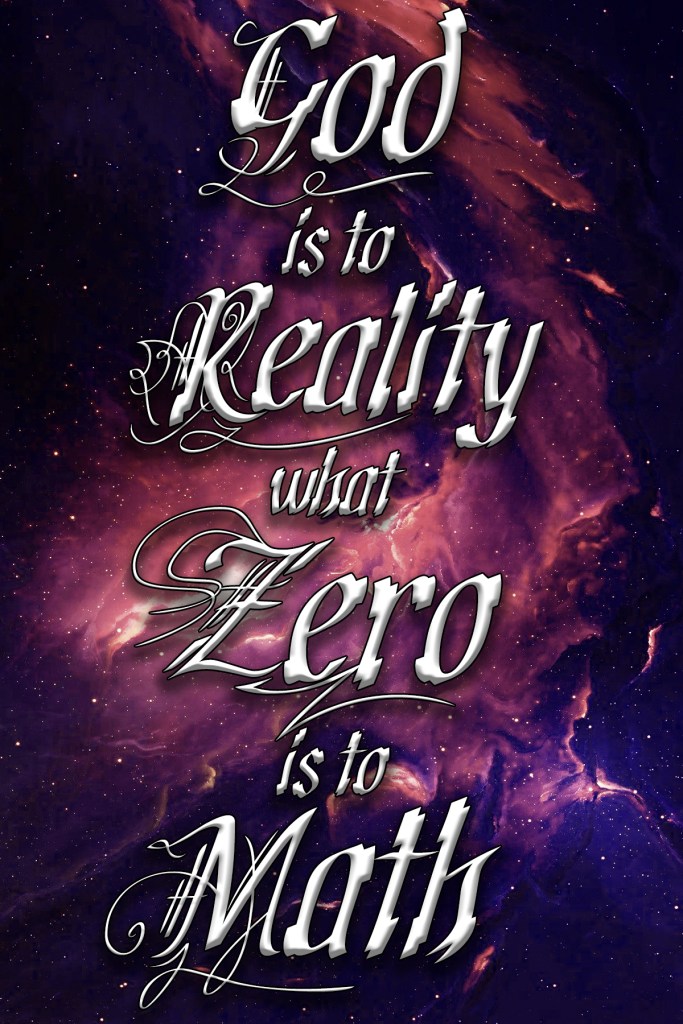
I lean heavily but not solely on the law of non-contradiction. I begin my contemplation of God by acknowledging that there is an absolute reality that exists independent of our perception, which we are able to witness from our relative positions and perspectives. This must be true because the idea that there are no absolutes would be an absolute, and therefore contradicts itself.
If there were no absolute reality that is independent of any witness, we wouldn’t be able to have shared experiences. If our perception had the power to shape reality, there would be no reason anyone would choose pain, poverty, or loss. The fact that unwanted experiences exist independent of our wishes confirms that reality operates without respect of observation.
Because there is an absolute reality, anything measurable must have a beginning because measurement itself requires one. Since something must exist in order to do anything, self-creation is impossible. Whatever can be counted or measured must have an origin that is immeasurable, as in having no measurable attributes. Here are the alternatives. They all lead to a contradiction:
1. The universe is eternal. The contradiction is claiming the finite is infinite.
2. The universe created itself. It is impossible to act prior to existence.
3. The universe has a creator that is an enhanced or superior version of what we already know. Even a being with supernatural traits unique to Him/Her/It would still be a participant in the reality that required Him/Her/It as the origin.
While trying to establish that the universe needs an origin, both believers and deniers go off track. They begin with what traits a creator must have. How in the fuck would any of us know?! Is there some model we are basing these assumptions on?! All we can ever witness or do is rearrange and reproduce.
My favorite is when people say a creator must have agency or will or something like that. The thing is: God created agency, will, and anything else like that, including intelligence. Can you even fathom what it would take to create those things? Me neither, but if you think my comparison between God and zero makes God seem mindless, just understand that it is a mindlessness capable of creating the mind.
That’s why I suggest we stick to establishing what a creator wouldn’t be. The creator would not be any of what was created. If it is that which is finite that requires an origin, then the creator would have no finite traits. If I try to use the word nothing to emphasize none of what we could perceive or imagine and no magnitude, detractors could use that word’s negative connotation to sidetrack what I’m actually saying.
Thankfully, we have a value that signifies no finite traits at the foundation of our most objective method of describing reality. We can use it as a tool to understand the creator according to its role and importance within the system. I summarize that line of reasoning with the analogy: God is to reality what zero is to math.
With God is Heaven or Hell
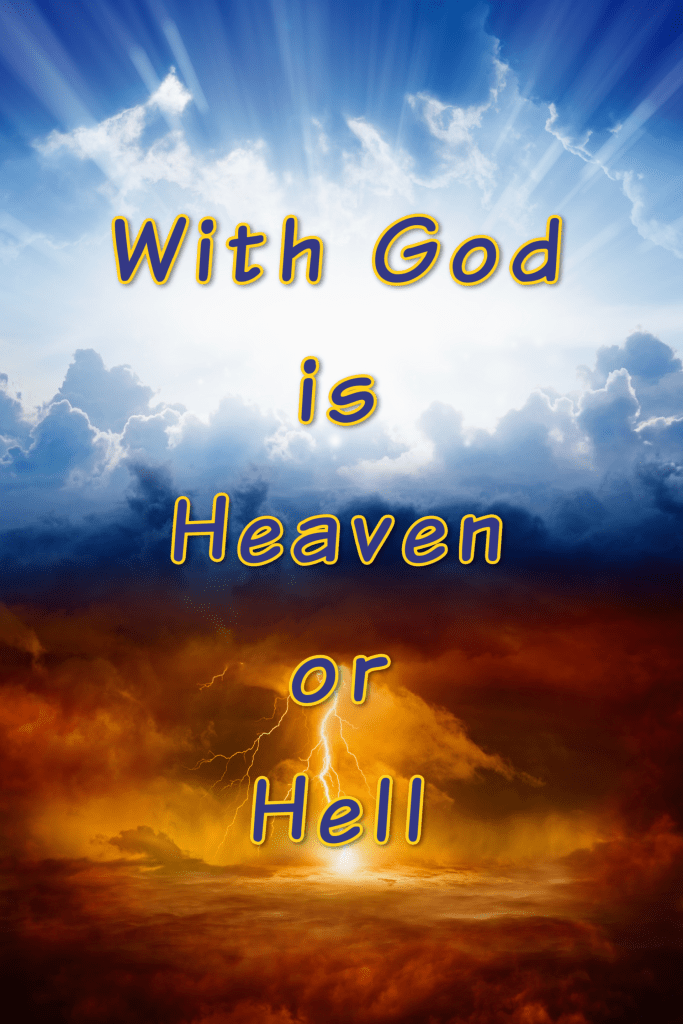
We learn about zero’s importance to math while learning about absolute value. The biggest paintbrush lesson that we can apply to life without any nuance would be understanding how worshipping God can impact how we view death.
The absolute has no opposite or equal, so the beginning will also be the end. Everything finite will cease to exist, and the only way for that to happen is to return to the Creator. There will be no positive or negative, except our perspective of the absolute.
Those who can see no purpose for the good since there is no negative will see the only way for complete and unending satisfaction. Those who love the good more than the Creator of the good will see an unwanted event that they hope isn’t real. Those feelings of satisfaction or unpleasantness would be extreme, so I say with God is Heaven or Hell.
Remember Those Two Facts

Because we cannot interact with a soul without a body and have no reason to believe the soul can be active without a body, there is no way we can be certain that we will be aware of the end as it is occurring. Being able to see the heaven of an event that could be hell can drastically change how you view life.
You can savor the good without ruining a good time and endure the bad without wallowing in misery. You can even find benefit in the bad when it isn’t too extreme. Preparing for your death to be the pathway to Heaven improves your life, so I suggest you remember God is to reality what zero is to math, and with God is Heaven or Hell.
It may seem like I’m putting a lot of sauce on my worth by calling myself a messenger of God. I will not argue the point because I am not the focus. Whether you see a philosopher, an author, or some guy linking God in reality to zero in math, objective scrutiny will show you I am right. This isn’t a joke, and I am not a fraud. I am Damond E. Anderson by birth and Hassan Bfly by merit. May peace be with you.