
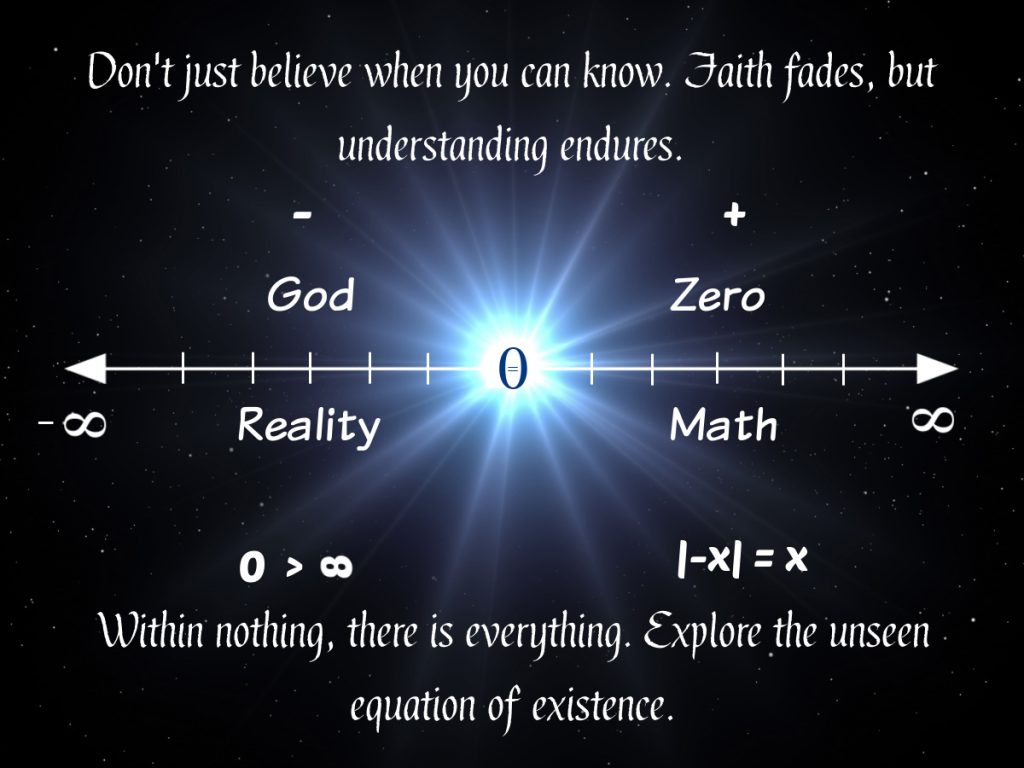
I realize math and theology aren’t subjects most would think to combine, but isn’t it worth considering what might happen if we tried to used math in order to understand God? We’re taught that God is beyond the reach of our five senses—senses that can easily be fooled. Yet in moments of doubt or complexity, we often turn to logic and math to bring clarity.
Surprisingly, when we apply fundamental mathematical principles to the concept of God, the comparison leads us to zero. Its role in defining the value of all other numbers mirrors God’s supposed role as the creator of the universe. Although we can ignore it, zero is always present. This parallel not only bypasses the logical flaws and fallacies tied to monotheism but also demystifies the very essence of God.
When pointing out the existence of the universe as evidence of its creator, the question often arises: who or what created the creator? Zero, as the origin of all measurement with no beginning or end, renders this question irrelevant. It demonstrates that an uncaused foundation can exist, negating the use of such a question to refute the concept of God.
To the religious, comparing God to zero might seem insulting or even blasphemous. However, it is the only logical way to explain why we can only describe God in terms of what God isn’t. This approach removes the opportunity to project our own ideals and virtues onto God, which may feel unsettling to some. For those accustomed to viewing God as a reflection of human greatness, this shift can be uncomfortable, even prompting them to shy away.
God in the Image of Man
Even without malice or ego, comparing God to zero can feel disturbing. Zero is often associated with “nothing” or the absence of whatever is being discussed. Yet, in mathematics, this perception falls short. Zero is not “nothing”—it is a necessary placeholder, representing the absolute origin of all that is measurable.
To measure anything, there must be a first. For there to be a first, there must have previously been none. Zero’s role as a foundational constant makes it immeasurable, which gives reason to our inability to produce any tangible or perceivable example of it. Our ability to ignore zero matches God’s perceived inactivity in the physical world. It doesn’t imply non-existence.
Sadly, any attempt to describe an absolute, infinite, and perfect origin for all that can be measured without reference to zero’s role in math will lead to some form of personification. It is difficult for us to perceive any superiority in ability as power or supremacy without choice or the ability to withhold access to those abilities. Once our characteristics are applied to God, absolute becomes all good, infinite transforms into larger than life, and perfect gets reimagined as ideal.
Regardless of intent, falsehoods get compounded with scrutiny. While projections of our virtues onto God may seem comforting on the surface, they also degrade our view of God into a glorified Santa Claus for adults who hands out rewards and punishments after we die.
While comparing God to zero may not seem flattering at first, it is actually much more accurate and complimentary than what we get from personifying God. All absolute value, by default, is inherently positive, so we don’t have to invent an equal rival to explain our ability to perceive negativity. We see that infinity is immeasurable and without limit while realizing what we call infinity within math is actually indefinite. There is no room for improving on perfection, so we don’t expect God to be an active part of our lives.
Life and Death
In this light, heaven and hell can no longer be seen as promises of reward or threats of punishment from a supernatural friend. Instead, they reflect the potential of how a positive or negative perspective can shape our experience of absolute reality. When applied to the most inevitable and dreaded life event—death—and the worst possible reality—the absence of everything we value in life—these states are not external destinations but intrinsic consequences of our alignment with or resistance to truth.
Worship isn’t an exercise in appeasing God as if the creator has something to gain or lose from our affection or the lack thereof. It is accepting and embracing reality as it is in order to make the best of any situation. The shift in perspective gained through the love of God is the key that unlocks inner peace and self-mastery.
Life, when seen through this lens, is vastly improved. The concepts of heaven and hell are not about sacrificing the richness of life to secure a supernatural reward or avoid eternal punishment; instead, they challenge us to sacrifice something much deeper: our expectations. Aligning with the absolute avoids the self-inflicted pain associated with resisting reality.
Every life philosophy hopes to achieve this state of amor fati (the love of fate or acceptance of all that happens), and many even promise it. Only accurately understanding the reality of God and embracing this information without bias delivers it. God is to reality what zero is to math and with God is heaven and hell are irrefutable facts whose benefits add motivation to accept them. Remember that.
Hassan Bfly

Theology for the New Millennium The Introduction of Intellectual Righteousness
Not a Book You Can Skim
It’s one you wrestle with, question, and revisit. It’s for those who crave depth, complexity, and clarity—not easy answers. If you’re prepared to rethink everything you thought you knew, this book will transform the way you see existence itself.
Few Wasted Words
The deep dives into the foundation of existence and the reasons we accept what we believe as true are packed with quotable lines. It demands your full attention, expertly keeping your mind engaged and focused.
Poetic Interludes
Righteous Rhymes are woven throughout the powerful prose, offering lyrical “study breaks.” These poems serve not only as moments of reflection but also as concise summaries and reviews of the key ideas.
Theology for the New Millennium – The Audio Ebook
Theology for the New Millennium is available in paperback on Amazon and audiobook on this site, but the ideal way to experience it is with the audio ebook. Read along as you listen to Hassan Bfly deliver this powerful message as the speech it was written to be.
Delivered as an MP4 download, this immersive listen-and-read format enhances your ability to fully engage with and contemplate the thought-provoking content. Get your copy today!