
Theology for the New Millennium:
The Introduction of Intellectual Righteousness
I don’t have all the answers
about God, but the ones
I do have are objectively irrefutable.
Contents
Chapter One – Rethinking the Concept of God
Chapter Two – Zero: Mental Unit or Real Value?
Chapter Three – Zero and the Attributes of God
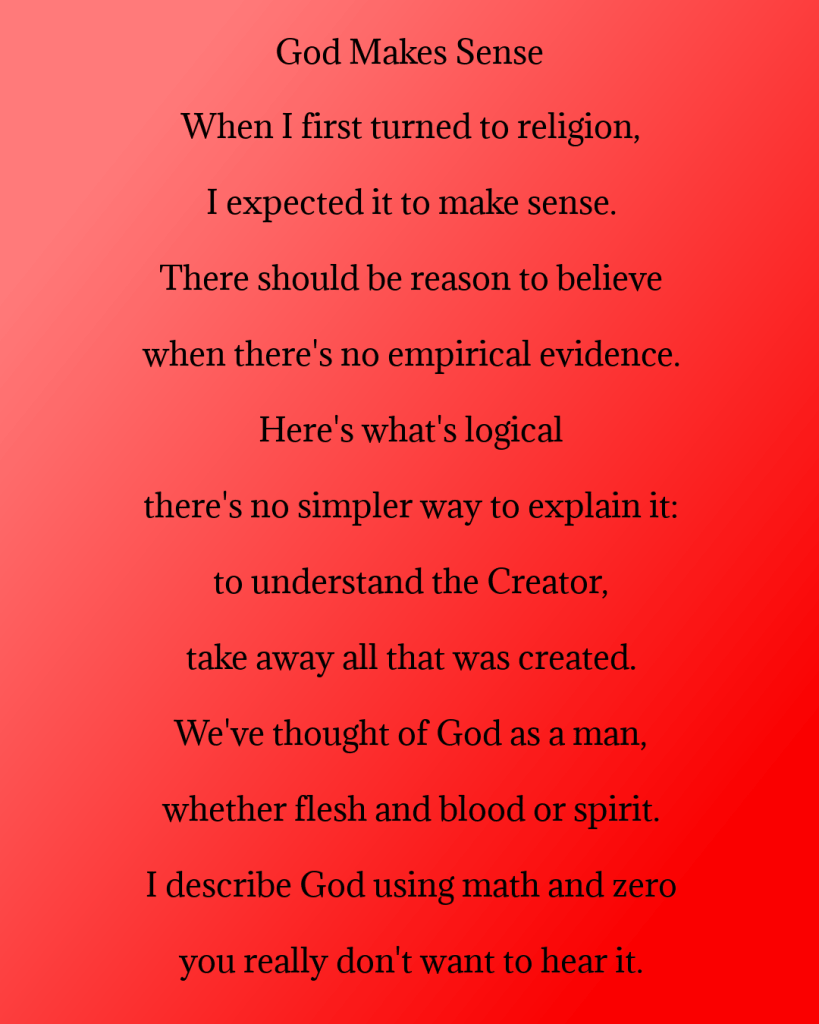
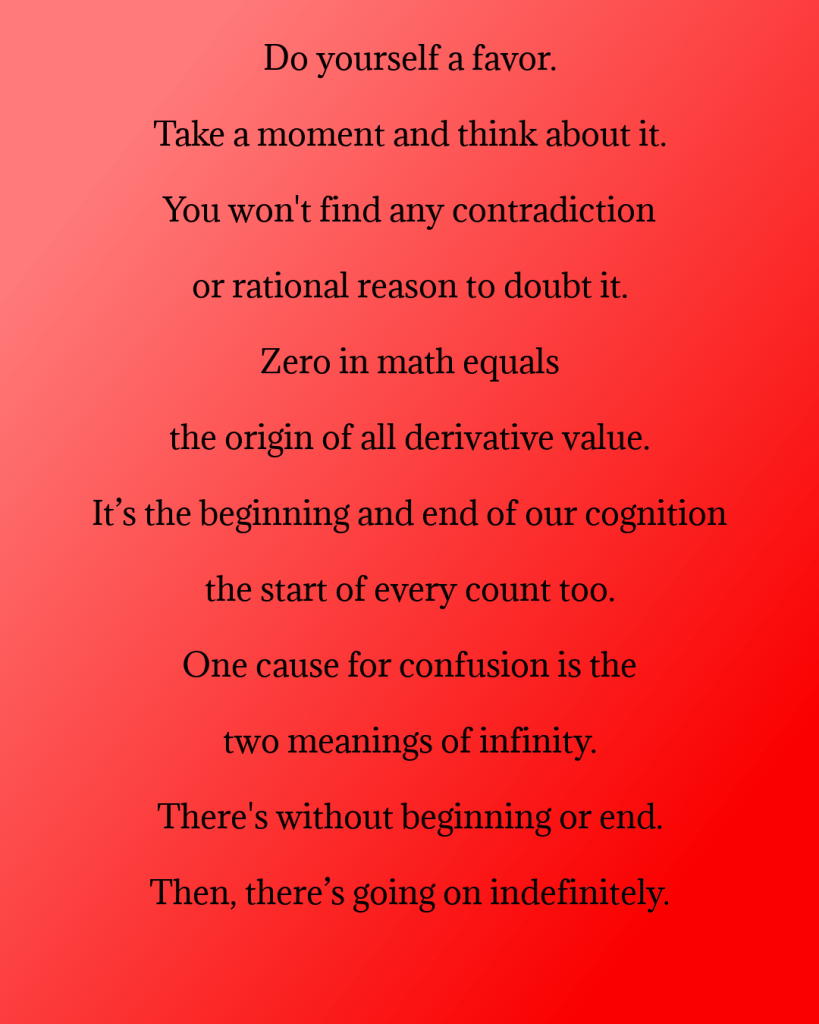
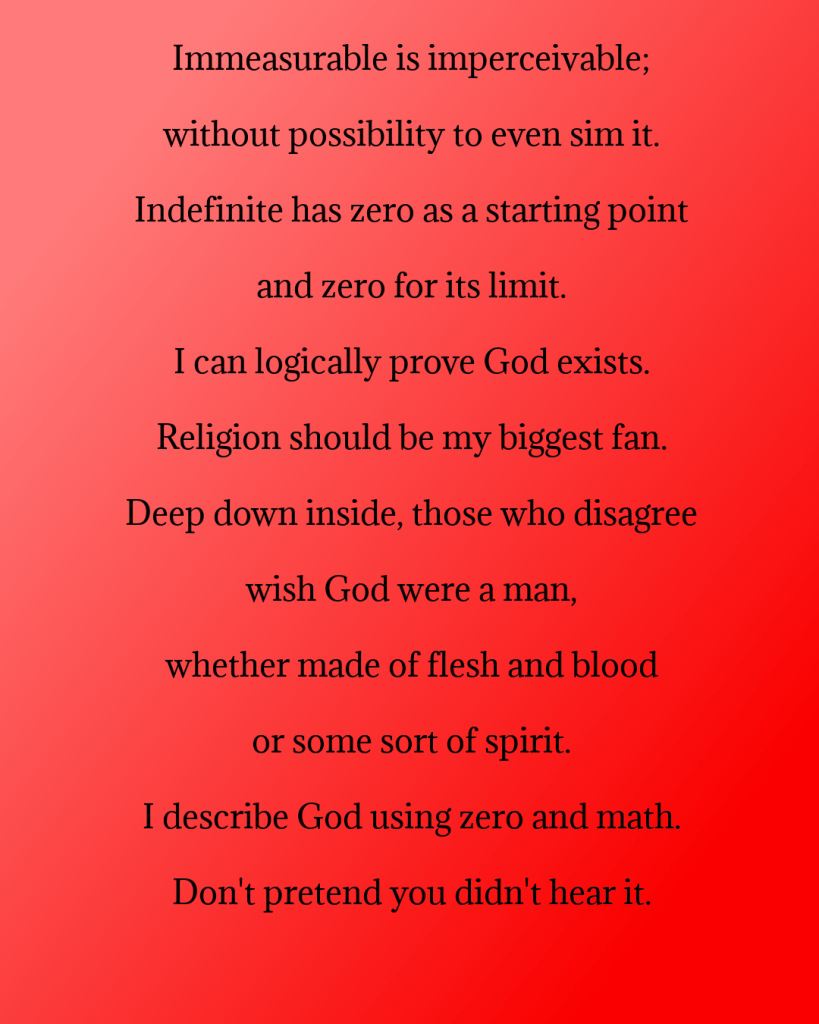
Righteous Rhyme – God Makes Sense
Chapter Four – Death is not the End
Chapter Five – Heaven and Hell
Righteous Rhyme – Shift Happens
Chapter Six – God and Perspective
Chapter Seven – Worshipping God
Righteous Rhyme – Think God
Chapter Eight – Sound Advice from the Ancient Religions
Chapter Nine – Sin vs Vice
Righteous Rhyme – Believe
Chapter Ten – I am not a Prophet
Chapter Eleven – The Breakthrough
Chapter Twelve – Bitter Pill to Swallow

Chapter 1
Rethinking the Concept of God
Isn’t it about time we got serious about what we’re willing to believe concerning God, Heaven, Hell, and the meaning of life? There are way too many versions of the truth for everyone to be right.
On one hand, you have a bunch of religious groups claiming they are the only ones with the right answers. On the other hand, you have the non-religious people who believe there are no right answers. The atheists among them say it is because there is no God. The one thing everyone seems to miss is these opinions or beliefs are based on somebody’s interpretation of words written or said a long ass time ago.
I don’t mean any harm, but it makes absolutely no sense for people living today, in what is supposed to be the age of information, to be stuck interpreting the words of people who believed the world was flat and the center of the universe in order to understand any subject, especially one that was supposed to be beyond their comprehension.
At what point do we turn away from decoding and deciphering dead languages and turn towards math and science? At what point do we recognize that if somebody in the past got it completely right, there wouldn’t be so many getting it wrong afterwards? When will we realize, or even consider, what was beyond the comprehension of those living centuries ago may be within our intellectual range today?
The ancient people believed in God based on faith, so that must be the right way for you, huh? Faith is an open admission that you not only don’t know if something is true, but you can’t possibly prove it one way or another. Any appeal to faith admits whatever you are asked to believe will contradict the things you already know.
For people who don’t understand as much about their surroundings, maybe the concept of faith makes more sense. People who know less would and should be more inclined to admit their ignorance rather than dispute what they don’t really understand. Confidence in knowledge and sincerity in belief could be the most effective way of swaying people’s opinion short of visible proof.
It should not be surprising that the atheist population increases as we learn more about our universe…there can be no empirical evidence or tangible proof for God and the conclusions within religion have been illogical, irrational, and downright contradictory.
That was then. This is now. Now, we have the ability to do things that the people back then would have called magic or witchcraft…things as simple as take a photograph or videotape someone…medical procedures like open-heart surgery or transplanting organs…building mechanized forms of transportation like cars or airplanes…digging deeper into reality by splitting the atom and mapping genes…travelling farther into outer space or witnessing the expanse of our universe through telescopes. People couldn’t do any of these things when any of the scriptures were pioneered.
That is not to say we have developed into some all-knowing beings or anything like that. We still have a lot of room for growth, discovery, and enlightenment. That isn’t done through faith though. Any form of learning must have a criterium or basic standard for distinguishing what is true from the multiple conclusions that can be drawn from whatever we witness.
Since contradictions don’t exist in reality, only exist in the minds of delusional people, anything worthy of being believed should, at least, be consistent and non-contradictory within itself. It should also be consistent and non-contradictory with anything else accepted as true. Not to be rude and state the obvious, but I haven’t heard of any ideology requiring faith that can take that miniature truth test and pass. Have you?
Even the idea of faith itself fails this test. The faithful believe it is our intellect that separate us from the other animals. That intellect is supposed to be a gift from God. Some would say that’s a part of God within us. Then, why must we go against it in order to believe in God or why can’t we use it to comprehend or fully understand God? It makes no sense.
I’ll go a step further. Without the ability to use even this mini truth test, how can you distinguish the real from the make believe, the liars from the legitimate, or the actual words of your chosen prophet from any forgeries by phony followers?
The answer is you can’t. Whatever words you try to use to defend faith against such a question will amount to you hoping your wants and wishes happen to match what is real. Since that’s how you feel, why bother reading any of the scriptures at all?! Surely, if your spirit is so inclined to God that you can use that alone to determine the truth from falsehood, then it should be able to just lead you right to God from within.
For us mere mortals, who must think and use our puny brains in order to know what to believe, any concept of God worthy of acceptance should not contradict itself or anything else we can prove. While I agree with the atheists’ stand that no theological doctrine or ideology to date meets those minimum requirements, at least none I’ve ever heard, I wholeheartedly disagree with anyone who says God does not exist. I assure you: God does exist, and you shouldn’t need faith to believe it.
We all know that the word, God, has different meanings, so first, let me define how I use the word God to eliminate any confusion. When I refer to God, I am referring to the creator of the universe as the only reality deserving of worship.
Any ideas about a Supreme Being sounds like some sort of intellectually superior alien to me. Some of you may want to scoff at me for believing in the possibility of life on other planets, but at least I haven’t turned them into gods. For anyone who doesn’t like me implying religious people are deifying E.T.’s, you tell me what you call a being that takes physical form that is not from this planet…I’ll wait.
As a matter of fact, I won’t wait because whatever you call him, it isn’t the creator of the universe and calling them both by the same name causes confusion because it is a contradiction…a physical being could not create the universe because the creator of the universe would not be a part of it or a participant within it.
I understand proving the existence of the creator of the universe beyond a shadow of a doubt would seem like something you just can’t do since it is impossible to exhibit empirical evidence to use as an example. While I may not be able to point God out to you like voila, I can introduce you to an understanding of God that is objective (meaning there is a right or wrong answer) and passes the mini truth test (meaning it doesn’t contradict itself or anything else we can prove).
Whether you are religious, atheist, or somewhere in between; if you think you have all the answers and your way is the right way, I’m not even talking to you. If your goal is to stick to whatever it is you already believe, regardless of what I say, please go away. We both know you’re just going to start making up stuff when you can’t find any truth to use to back up your argument.
If you have doubts or questions and you honestly seek the truth whatever it may be, you should listen and listen carefully. You shouldn’t just believe what I say either. Give these words honest scrutiny and judge for yourself.
Let’s play a philosophical version of big bank takes little bank with our versions of God on the line. It’s sort of like “if you can’t beat ‘em, join ‘em”. There will be no witnesses, so you can be honest and keep it real with yourself. In losing, you will win.
It won’t be easy. It could get boring at times. There will be times that I may challenge things that you never thought to even question. I may get into subjects that you never learned in school or ones that you forgot as soon as you got out. I might use a few big words that send you to the dictionary to get what I’m talking about. I may just criticize something you believe in a way that pisses you off, so you won’t want to agree with me. This isn’t about me though. This is about you getting to know the truth concerning this God you’ve heard so much about.
Earlier, I defined God as being the creator of the universe. In trying to describe this creator, people have been in the habit of using words or ideas that allow room for sensory perception or imagination. While such a tendency may seem logical to us because they are the tools we use to learn about everything else, that tendency leads to confusion when it comes to God.
Because all we can ever do is discover and invent, we tend to forget or never even realize: a creator must have existed independently before whatever was created. That means the creator would not be made of, dependent on, or limited by anything created.
The first step in understanding the Creator would be to mentally negate or eliminate everything that was created. We’re talking about the universe, so that means absolutely everything. You may think if you take away everything, you aren’t left with anything, but you are. Take away everything, and you’re left with…God.
It would truly surprise me if you didn’t finish my statement with another word in mind. That word you thought of is the most accurate definition or description of God, but it has different meanings and a connotation that is unfit to be used in reference to God.
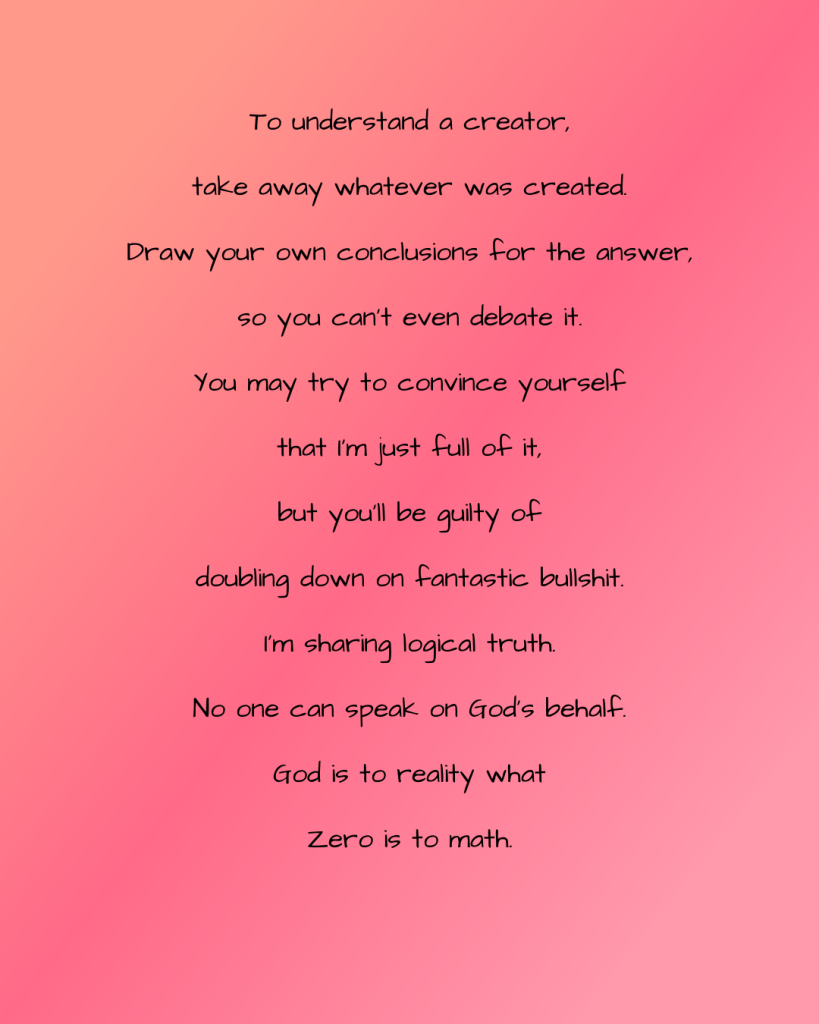
To avoid the negativity, confusion, and what would sound like blasphemy if I were to say: nothing is God or God is nothing, I’ll give you an analogy. It is my mantra: God is to reality what zero is to math.
Let that marinate for a moment while remembering I said God does exist. What I’m saying right now is the role that the absolute value, zero, plays within the science of quantifying the attributes of everything in the universe is the same as God giving those things the attributes themselves in reality. It is in fully understanding the role zero plays within math and applying that to theology, that we can get to know God in a way that is non-contradictory and irrefutable. God is to reality what zero is to math.
Chapter 2
Zero: Mental Unit or Real Value?
It’s funny. Even though I shocked and scared myself and thought I committed the worst blasphemy of all time when I initially made the breakthrough that led me to the analogy, God is to reality what zero is to math, I still get surprised when both the religious and atheist reject this concept. Somehow, people seem to think I’m saying God does not exist. That’s just asinine.
I can only suspect or assume such nonsense stems from people believing zero is not a real value…it’s just a mental unit. For the life of me, I can’t understand how anyone can believe the value that is necessary to define all other values is a figment of man’s imagination.
I’ve heard people say things, like: numbers existed before zero, so it can’t be necessary to define them. What can I say to that? They’re right…numbers did exist before zero just like things fell before we discovered gravity.
People act like we invented math. Sure. Somebody invented the sounds and the symbols associated with math, but the principles themselves are discoveries, just like gravity.
Now I ask you, in discovery, which comes first: the obvious or the subtle? The answer is obvious. Zero was always present and necessary to give value to all other numbers. In order for there to be a first of anything, there must have previously been none. It just took longer to discover or understand its significance.
Don’t believe me? Try something simple, like counting with your fingers. You don’t start with one, even though you may have assumed you do. You start with a closed fist, symbolizing zero as your start, before you flick out any of your fingers.
Don’t you know, whether you’re religious, atheist, or somewhere in between that rejecting the concept of zero relating to something real and unimaginable means you must reject or contradict something you claim to believe?
If you’re religious and believe God is the Creator of everything, then the only way to define that Creator is to mentally get rid of everything. Do that and you’re left with “nothing”, which would be represented numerically by the value zero.
If you try to relate to God in any other way, it would be associated with another mathematical value. Whether it be negative or positive, partial or whole, constant or variable, rational or irrational, or real or imaginary; every value is defined by its relation to zero.
Some of you would have said before today that God created everything from nothing and today will say nothing doesn’t exist at all in order to disagree with me. Make up your minds. Before you try to stick to your original claim, as if God and this Nothing from which everything else was created can be two separate realities, consider this:
You cannot bring nothing into existence. To do so would be to actually, not mentally, destroy everything else. God couldn’t create Nothing without destroying everything else, including “Himself”. That would still leave Nothing as the only source for all that now exists.
The idea of God creating “Himself” out of Nothing is just as flawed. You must exist in order to do, so the idea of self-creation is self-contradicting. How can someone or something commit an act before they exist? The answer is: they can’t!
Now, for all of you who don’t believe God exists, whether you’re open to the possibility or not, I agree. The concept of God within religion contradicts itself way too much for any logical person to believe.
I say that first, so if you interpret anything I say as co-signing any of those theological beliefs, you are misinterpreting mine. The analogy, God is to reality what zero is to math, sounds like blasphemy to many of those who accept any of the ancient religions as true. I disagree with the idea of faith just as much, if not more than you.
In your attempt to embrace logic and reason, you have failed to see you’re on the opposite side of the same irrational coin. You both are unwilling to let go of your need for sensory perception or imagination for learning.
Before you get upset with me for pointing out the truth, let’s get down to the essence of your religious rejection. If you keep it real with yourself, you will admit it isn’t because the concept of a Creator of the universe is irrational or illogical.
The idea of a single origin of everything else makes sense to you until you try to imagine what that Creator must be like and realize you can’t without contradicting yourself. Instead of giving up on your imagination, you gave up on your creator.
Don’t believe me? Ask yourself why would you disagree with God is to reality what zero is to math, and the answer would undoubtedly be because you cannot imagine a reality that could be represented by zero, even though you may be willing to recognize the necessity for zero in math.
You just want to skip over the logic of this rational conclusion: math is the most objective science and the most honest language for defining or describing the attributes of reality. In order for numbers to be relevant, they must relate to reality since they must quantify or describe something. The value of every number is defined according to its relation to zero. No zero, no numbers. It makes no sense then to believe zero is a mental unit invented by man. It is the only necessary value in math.
You shouldn’t be able to perceive or imagine the reality zero describes or relates to because sensory perception is your matter’s recognition of the matter outside of you and imagination is just its simulation. How could you and why would you expect to witness or imagine the reality that created matter? Where is the logic or reason in that?
I’ve had people try to debate with me by using the law of conservation of matter and energy, (as if I’d forgotten my junior high science lessons) when the truth is I thought about it more than them. If you don’t really remember it, don’t feel bad. I vaguely remembered something about matter and energy not being able to be created or destroyed.
It wasn’t until after I made my breakthrough that I went looking deeper. My motivation then was to disprove what I had just discovered in the hopes of not having to be a pioneer in a contentious and opinion driven subject like theology.
To my surprise, what I found was: the law, in its over simplified form, is false. Don’t get me wrong. The law of conservation of mass is spot on. It is evident through observation and experimentation that no new thing is created and no already existing thing is destroyed by any physical interaction. Things just get changed and rearranged. That is not because matter and energy cannot be created or destroyed. It’s because neither matter nor energy have the power to create or destroy.
How do I know? Contradictions don’t exist in reality. If matter and energy could not be created or destroyed, that would make them infinite. It is impossible for something to be both infinite and finite. If you can measure it in part, its entirety is measurable, even if it’s not by you. If it’s measurable, it must have a beginning because measurement itself must begin and end somewhere.
Before there could be a first of anything, there had to be none, because in order for there to be a first, there must have previously been none. The beginning of every count or measurement is zero.
The ironic thing about people trying to use the law of conservation to argue for an infinite universe is, without the creation of anything new taking place in real time, the law proves the mass of the universe is not just finite. It’s a constant.
I’ve had people try to point to space as something that is infinite, but we can measure in part. Indefinite and infinite are synonymous, but they are not exactly the same. Indefinite is finite but cannot be determined at the present time by us, usually because its range exceeds our perception or imagination. That symbol that looks like a sideways eight; that’s indefinite. You can count up to that. Infinite is immeasurable. It is without beginning or end. You cannot count up to infinity.
For those who think space is infinite, I ask you: does space become something immeasurable at some point? I don’t mean is it too big for us to measure in its entirety or does its expanse get so far away from us that we can only imagine how much farther it stretches. I mean does it become something that is impossible to measure.
If the answer is yes, that point marks the end of space because it has become something totally different. If the answer is no, then there is an end to space that has yet to be determined. Either way, space is measurable throughout; finite just like everything else we can sense or imagine.
The idea that math and science go against theology is as mythical as the unicorn. Even the idea that the big bang theory goes against the concept of a creator of the universe makes no sense. It is a theory on how God created the universe. Of course, it’s going to begin with the smallest non-zero possibility since that would be the first theoretically perceivable or imaginable reality. You can’t start from nothing and go straight to something huge. Whether it’s fast or slow, expansion is a gradual process.
Whatever that first perceivable part or first phase of the universe is, it shouldn’t be called a singularity. Not to be redundant, but a singularity is singular…meaning it is one lone, distinct, and unique reality. There can be no possibility for multiple singularities. What anti-God big bang theorists try to call the beginning of the universe can supposedly be found at the center of any and every black hole.
How can the beginning of the universe be found within it? That sounds like the same contradiction that makes them reject religion in the first place. At least the religious openly admit they don’t make sense, even if they don’t realize it, as soon as they appeal to faith.
Let’s be clear, sane, and reasonable. There must be a creator of everything in the universe because it is all measurable and finite, which means it all has a beginning and end. Since anything measurable and finite would be a part of creation itself, the Creator must be infinite and immeasurable, singular, without opposite or equal; a reality that can only be represented by zero. God is to reality what zero is to math.
Chapter 3
Zero and the Attributes of God
Besides our inability to imagine the reality that would be represented by zero, people have extra motivation to try and disagree with the analogy, God is to reality what zero is to math. We are so accustomed to thinking of ourselves as the most superior reality, that too often anything believed to be better than us will be seen as improved versions of us. This is so true that many of you reading now are trying to convince yourselves that what I’m saying is irrelevant because, even if I’m right, my version of God is just some mindless inanimate object.
Let me make this clear: every attribute of God that is universally accepted by all monotheistic concepts of God apply to the mathematical concept of zero. Before you start to wait or anticipate my explaining how zero could be loving, merciful, or even jealous, you should pay attention to what I just said.
I didn’t say any. I didn’t say some. I said all. Not all monotheistic ideologies subscribe to those attributes, but they all believe God is absolute, infinite, and perfect; even the religions with an emotional God. If those universal attributes don’t sound like zero to you, we’re thinking about two different zeroes. I’m talking about absolute zero while you’re still thinking about relative zero.
Zero, when defined in relative terms, is either something neutral, meaning it is powerless to do anything, whether it be good or bad, or it represents none of whatever is on your mind at the time: something specific. Since that specific thing is typically desirable or seen as something good, zero is seen as negative.
These are not godly qualities, so they could never help you understand God. In fact, trying to apply such qualities to God will take you further away from the truth than any other contradictory concept I would criticize. Avoiding this counter-productive train of thought is why I wish I could avoid comparing God to nothing or zero in the first place. Such an interpretation of my words is why the analogy, God is to reality what zero is to math, sounds blasphemous on the surface.
I know…when we first learn about numbers, we use examples before we start getting into number theory and absolute value, so it isn’t far-fetched to try that with zero. Zero is unique and unlike anything else in math, just like God is unique and unlike anything else in reality.
While we may find examples of relative zero as none of something, we cannot find examples relating to absolute zero because that would be none of everything. That includes none of the things we need for our existence and cognition…things we can’t imagine reality without, like: space, time, matter, energy, light, or life; even the non-physical elements of reality, like: love, hate, consciousness, ignorance, desire, or pleasure. When I say nothing, I mean Nothing!
Absolute is neither positive nor negative, but can be perceived as either…without equal, opposite, or peer…unconditional, independent of all else, yet on which all else depends…unavoidable, undeniable, and eternal. All these definitions apply to zero on the number line and none of them can apply to anything else in reality except the Creator of the universe. God is to reality what zero is to math.
I must stress the role zero plays on the number line to make myself clear. Here is why: the only example of zero we can use as a point of reference for understanding God is zero as it appears on the number line; what it does in math from that position and the attributes that come with it.
That absolute value, zero, never interacts with any other value. Attempts at addition or subtraction amount to counting up and considering your perspective as either positive or negative. You cannot multiply zero because there cannot be multiple zeros. It is singular, so there can only be one. It’s the same with division…impossible. God is Unique and Singular…the Unseen and Unimaginable.
Negatives and positives are not absolutes, as in not real states of reality. They represent perspective, since the positive is what’s desired, and the negative is the opposite of what you want.
The necessary attributes, meaning the real or absolute value without concern for perspective is determined directly and only by their relation to zero just as God is the Giver of the attributes those values represent, the Creator of all.
I mentioned zero is Infinite earlier. It is the beginning and end for everything else and there can be no beginning or end of it just as God is the Alpha and Omega. I remember I was in high school when I should have made the connection. My mind was far from God or religion. I was just concentrating on not failing:
I was in one of my advanced algebra classes. We were working on limits, and the teacher moved the class quickly. He didn’t dwell on any lesson too long. I wasn’t getting what he was saying. Whenever I ran into this problem before, I would pick a random problem out the book, get the answer, and then work backwards. I really didn’t understand what I was supposed to be doing, so I started punching numbers in on my calculator to see if I could figure things out…
My calculator must have been broken or something because it said zero whenever I hit the limit button. If I hit it again, it said error. This happened even when I punched in what I thought was infinity.
I had to stop my teacher to ask what was wrong. It was then that I learned the symbol that looks like a sideways eight wasn’t really infinity. It’s indefinite. The limit of every value, including the sideways eight, is zero and only zero has no limit. God is Infinite, the Unlimited.
This unlimited aspect of God gets distorted into some sort of Greatest or Most High. We tend to think the best is the biggest or highest in positive perceived magnitude because it overcomes, eliminates, or reverses the most perceived negative. The good itself overshadows the desired state so much that you miss understanding perfection would be if there was no negative and no excess. No negative or positive is zero, but we would rather focus on the good that would give us that, in theory. God is Perfect.
From this train of thought, it is clear that the best or true superlative comes from no negative instead of from more positive. Instead of thinking of the All-knowing as having some really big brain, think of no possibility for ignorance. Instead of thinking of the All-powerful as can do anything, think of dominion over all. God isn’t active. Any act is an attempt to improve, and you literally cannot improve on perfection.
I’ve heard people argue that the concept of an All-knowing and All-powerful God contradicts the idea of free will. That would make sense if God were spying and meddling in our affairs. Whatever happens was made possible by God, but what takes place isn’t caused by God as much as it is allowed.
The inanimate are bound by whatever laws govern their identity, purpose, movement, or interactions with anything else. The animate are bound for failure whenever they inaccurately assess or appreciate whatever they can access, wittingly or unwittingly.
The attribute of absolute zero that is causing me to have to do all this explaining to show you zero deserves higher esteem in the first place is Invaluable or Priceless. Unlike all the other attributes of God, which are objective, this one can also be subjective (meaning according to the eyes of the beholder).
Objective value comes from zero. This truth is applied subjectively, most times without our noticing it, as our relative value for what we encounter, acquire, or experience comes from knowing or imagining what it’s like to be without. This gives us a tendency to take for granted what we think will never be gone.
Since we will never directly witness God while we live, by our usual standards, God can be ignored and taken for granted, even though there can be no universe without God or value without zero. I’m not talking about some misinterpretation of what I’m saying, either. You can understand what I’ve said and agree with it all up to this point and still ignore God without any change in circumstance or concern for new repercussions.
Just because it is possible to do something, doesn’t mean you should. Consequence is no coincidence. God doesn’t have to meddle in our affairs to rule. God is All-powerful. Sure. You can ignore God and fail. There are objective laws governing reality.
There is no way you can ignore truth except by substituting it with lies and delusions; your wants and wishes in spite of what’s real. How can you be right with reality when you have such a mentality? Why would you want to ignore the truth, anyway? What lies have you told yourself that you’re unwilling to let go?
Whatever they may be, enjoy them. Whether they help you cope with life or amplify and intensify your woes, they cannot last throughout your existence. With God is the end of all things, and God is the only Judge. In the end, the only opinion that matters is your own, literally. God is to reality what zero is to math and with God is Heaven or Hell.
Chapter 4
Death is not the End
It gives me great pleasure in disappointing anyone who expects me to appeal to faith at this point or thinks I need to. Just as I proved the existence of God through reason without contradicting myself or anything else we know, I will point out why our existence does not end when we die and how our final judgement is from God and God alone.
As with God, lack of empirical evidence or the inability to imagine a reality is no just cause to believe something that makes no sense and contradicts itself or other things we should believe. We cannot just take liberties to make up what suits our fancies in order to have room for some sort of imagination.
Here is what we have reason to believe about what we call the soul even though it gets constantly discussed and debated: the soul is an immaterial creation that gives self-interest and awareness to matter, producing material beings. It is within all living things.
When I say the soul is not composed of matter, those who want to disagree will falsely make it out as if I’m using what we don’t know to prove what we know. I’m actually going by something we know though: a defining characteristic of matter is inertia. In a nutshell, that means matter don’t start nothing and don’t end nothing. Matter neither moves itself nor stops itself once in motion…ever.
My saying that our souls are not made of matter does not imply I’m saying they are non-physical or existing outside the universe. My soul and I are one. As long as I live, we are inseparable. If I am here, then my soul is here…in this location. I am my soul.
According to what we know about physics, forces and energies move matter. The energy needed for our actions is calories and is interchangeable with matter. I wouldn’t think they have anything to do with the soul.
It is reasonable for me to conclude our souls are a type of force. What type of force? I don’t know. I’ll let the scientists figure that out. I’m just a philosopher using deductive reasoning and the process of elimination.
That is to say: I’m not saying our souls are our life forces because I am certain it’s a force. I’m merely making myself open to the most logical non-contradictory possibility being true. If all other conceivable options contradict themselves and other principles, where is the room for debate? It is not just possible; it is most plausible that the essence of our existence is not composed of matter, yet it is a part of our physical universe…bound by the laws of physics, known and unknown.
One reason I stress the fact that the soul is not material is to dispel the myth that we named a part of our mind, the subconscious, a soul. Let’s talk about this organ that is so mysterious that people think they can make up stuff about it.
First of all, it is flesh (matter), which means it ain’t the initiator of anything. Need I say more? I shouldn’t have to continue, but I will. It is the center of our nervous system. Nerves are biological sensors and information transmitters. The brain gathers and sends information. That sounds like a bridge, conduit, or middle man to me. The mind is a bridge between our bodies and souls; between the matter that gives us access to the world and the force that moves and motivates it.
Of course, the mind does more than that. It also interprets, calculates, recalls…maybe everything else fits into one of those three categories. The point I’m about to make is desire is at the root of action. The mind senses that desire, formulates a plan for satisfying that desire, and if successful, commands the body to carry out that plan. The body does what it’s told. Things outside of us happen that affect our bodies. The body senses these events. The mind interprets the information and reports the results. We are either satisfied or dissatisfied by the results.
There are a lot of nuances and back and forths that I’m skipping over. I think you get the point though. Desire and appreciation seem like mental functions because it is through the mind that our bodies become aware of our wishes. The urge we call desire and awareness of its existence are not the same thing nor do they happen at the same time. That should be enough of an indicator that the soul is not a part of the mind.
Think about it this way: the soul is the cause for all action because it is proactive. The mind, on the other hand, is reactive…mental functions are all the results of chemical reactions. It reacts to the wants and wishes of the soul in order to come up with a plan for action. It also reacts to whatever the body experiences in order to interpret the information it feeds the soul.
I know…it’s funny talking about a force of some sort having feelings like desire and appreciation, but it makes more sense than believing dirt and water or stardust can do anything at all without a motivating force manipulating it.
That’s another reason I want to stress the soul being immaterial. I’m getting a little ahead of myself, but I just want to point this out now while I’m kind of on the subject: this thing with people making themselves out to be slaves of the flesh.
Matter is inert. It does what it is told, from within or without. Perception is not a choice. What we sense and perceive is as real and as accurate as our cells can give us. That’s the without. Everything else comes from within. How you react to whatever information your body gives you is a choice.
Do not let the natural urges we have fool you into believing the flesh is ever in control. Of course, material beings will have material needs: survival of the individual or genes have requirements, and there should be some consideration given to comfort and pleasure. It is you who sets the guidelines, and no matter what words you say out of your mouth, your body will do exactly what you truly want.
What the soul seeks is harmony with reality. When there is conflict between the two, it can be easier to feed the mind lies in order to filter the information you receive or find distraction in sensual pleasure than it is to change whatever values or priorities that are causing the conflict because your matter is the part of you that can’t resist.
Your soul can resist and even outright reject what is real if you don’t want it to be true or wish it were false. It can also keep you from doing what you know you should do just because you really don’t want to. Your body, on the other hand, can never stop you from doing anything you want to do or make you do anything you don’t want to do because it is never in control of anything.
Which brings me to the final reason why I must stress the soul is immaterial: death cannot be the end of our individual existence. Matter and energy have no power to create or destroy, so no physical occurrence can destroy our souls.
We all know about how our bodies break down and return to the cycle of life. What happens to this force is not as evident, which leaves plenty of room for debate, discussion, speculation, and fabrication.
I can honestly say: I have no idea what happens after we die. Even the ridiculous seems possible. Instead of focusing on what cannot be logically proven, I focus on what is irrefutable and draw logical conclusions from that.
The only thing we have reason to believe with absolute certainty is this: the only way to cease to exist as individuals is to return to God. Of this we can be certain because that is the only way any creation can cease to exist. Whether we only get one shot or a bunch of mulligans in between, it is in that end of our individual existence that our values will be judged.
You may wonder how the end of our individual existence can be a time of judgement. It’s really quite simple. Our soul, which is the source of all self-interest, self-awareness, or want; the acceptor or rejector of what is true or satisfactory, returns to God: Timeless Perfection that can only be defined by us through the absence of all else. What we loved in life will determine whether we enjoy the experience or not.
I’ve heard people say nothing happens after we die. They just don’t know how literal and true that statement is. The question is will we be aware as this “nothing” occurs. I am inclined to believe we will be, but I cannot speak on it with absolute certainty.
There are too many unknown variables to consider like: reincarnation. Is it real or wishful thinking? Do we stay in our lane or do we move up or down the evolutionary ladder? Does the mental capacity of the matter affect the awareness level of the soul? I don’t know enough to rule out any of the possibilities and I doubt if anyone else does either.
Instead of filling in gaps of knowledge with assumption and speculation, I admit what I don’t know. Instead of focusing on possibilities and lives that may never be, I will treat this life as the only one I will ever have because it’s the only one I will ever know while I’m alive.
According to what I know in this life, I expect to be aware of my final instance of individual existence. In fact, I would expect to be more aware of that event than anything I experience while I’m alive.
Sensory perception is fallible, so any conclusions we draw based on such information is questionable. This is why we have the option of accepting or rejecting reality in spite of how much information we have.
Rejecting what is real feeds the mind lies because it is a calculator that will try to draw whatever rational conclusions it can based on the information that is accepted as true. The delusions that come from perverting the soul’s defense against the fallibility of the flesh can be used as a shield from unwanted truths. Where can anyone hide from the truth when there is no body to doubt and no brain to confuse?
There is nowhere to hide from the Creator of all. Just as everything came from God, so must everything return. There is no reason to hide from the one that created an absolute universe and gave you perspective so that you may appreciate it.
Do not appreciate it so much that you become unmindful or ungrateful to the Absolute. Your perspective will be the source of your total satisfaction or the instrument of your worst torment. With God is Heaven or Hell.
Chapter 5
Heaven and Hell
Contrary to popular belief, there is no judgement in which God is presiding to send you to Heaven or Hell. They are one and the same reality: that last moment of individual existence when we become one with Nothing. This meeting with God does not lead to a new reality. Uniting with the Timeless lasts an eternity from our perspective even though it would be unimaginably brief in reality.
Such an event should be a blessed occurrence for all. That’s the thing about perspective: it’s just as possible to ruin even the best of all possibilities when you have a negative perspective as it is to benefit from the worst of possibilities when you have a positive perspective. What should be Heaven could be Hell.
God is to reality what zero is to math. For the person with the wrong perspective, to be one with such a reality would be unpleasant, to say the least. While being in the presence of perfection and free from material needs, the person with the wrong perspective would focus on what’s missing, which in this case, would be everything. If you think it’s rough when you’re missing someone or something in life, just imagine how much worse it would be to be missing everything.
It may not seem so terrifying because we all have coping mechanisms and strategies to overcome loss. Even if you’re honest in the way you cope with hardship while you live, no adjustment is possible after you die. There is no mind to change or time for it if there were.
Needless to say, if you make it through life with lies and delusions, that missing mind just eliminated the possibility to lie to yourself anymore. Whatever would be felt in the beginning will be felt throughout. The pain of Hell is everlasting.
Because it seems easier to get over emotional pain than it is the physical, if I really wanted you to imagine and relate to how great the torment of Hell is, I would liken it to the emotional equivalent of being burned alive without the escape of death as a means of salvation.
I say this not because that is how the ancient religions describe Hell. I don’t know any pain worse than getting burned, but if you do, by all means, imagine that happening all over your body without the ability to die. The point is to evoke thoughts and feelings of the most excruciating pain without end so that learning this reality isn’t just theoretical or academic. It is the realest and most certain event to take place in our entire existence.
I seriously doubt that religious people really like my depiction of Heaven and Hell. I think too many of them are hoping for an abundance of new and improved versions of what you can get here as a reward for believing there is a God and following as many of the rules of their religion they are willing to accept.
If you’re religious and that depiction doesn’t apply to you, congratulations on not taking luxurious descriptions of Heaven literally. If you’re religious and you feel like I just called you out, that’s your guilty conscience talking to you. Now that you’ve identified yourself, allow me to join the conversation by pointing out just how phony you are:
In order for any of the imaginary depictions of Heaven to be in line with reality, access to excessive sensual pleasures and luxury must be meant to evoke the feeling of freedom from material need. The best way to conjure up the feeling associated with no hunger would be an abundance of food with no possibility of getting full so that you may continue to please your taste buds. To eliminate any thirst, there is also an abundance of drink that gives you a buzz without the sickening feeling of drunkenness or hangover. For no discomfort you have fluffy fancy couches or clouds. The list goes on and on. You name a natural desire, there is some figurative way of explaining the absence of that urge through material means.
Instead of worshipping God, those of you who have taken what was meant to be figurative literally thought you could trade with God as if you have something to offer the Creator of all. Even though you claim to have faith, everything you believe about God and Heaven are material and imaginable. While you may have fooled yourself into believing you are not carnal minded, you have not fooled God.
We are not employees laboring for God with Heaven as a wage. God has no vested interest in what we do. Heaven and Hell are opposite perspectives of the same reality that awaits all who lived. Any labor we do is to prepare for that reality to be heavenly.
It is within your power to make it happen, too. The material depictions of Heaven don’t come close to the reality. It’s not just because the material is superficial while the soul is deep. It’s also because harping on the freedom from material need misses out on all that no negative includes: there is no pain, no fear, no stress, no confusion, and no concern for the future because there isn’t one. For those who truly worship God, the joy of Heaven is ever lasting.
Yes, the soul is deeper and more intense than the material, too. Just think about it like this: we can accept or reject the information from our bodies, even when it’s true, because sensory perception is fallible. What we sense can be misleading, can get distorted, and can be overlooked or ignored. Without that body though, that which wants and appreciates within us will be with the Perfect Reality.
We will be in God’s presence, so there is no room for doubt or speculation. The soul will be naked, like an exposed nerve. Whether it’s torment or bliss, the feeling would have to be more real and more intense than anything we could imagine.
An abundance of food and drink without getting full or drunk seems too cheap, petty, basic, or common to compare to Heaven. There are way too many things that excites or dull the senses for people to be impressed with not missing a meal as Heaven.
If I were to try and depict Heaven physically in order to give you an idea of what it must be like, I would really have to get carnal, debauched, and amusement minded. In describing Heaven, it can’t be about what I like or what most people like. It must be about what you like. There are five senses to excite and more urges to satisfy than hunger.
So just imagine, if you will, all your bills are paid forever. You are relaxing in the most comfortable position possible on cushions that feel as light as air. You are experiencing the high or buzz that you like, and it is more intense than usual without any of what you consider to be a downside. You’re in a constant orgasmic state. You can always and only see whatever tickles your fancy or pleases you, while listening to whatever is your favorite music. Sounds great, right? Throw in an abundance of food and drink, and it still ain’t as good as Heaven.
I understand we are material beings living in a material environment, but what we desire runs deeper than material needs. What we truly seek is peace and harmony with our reality. The body is a double-edged sword. It disturbs your peace with concerns for survival, comfort, and sensual pleasure, but it helps you achieve harmony by allowing you to act in a way that gains temporary satisfaction. It’s the struggle that is life.
The only way to gain total satisfaction permanently is to be free of the flesh without any time for change. That event will definitely take place. Don’t ruin it by wishing for what was never good enough in the first place. With God is Heaven or Hell.

Chapter 6
God and Perspective
So now what? Are you ready to accept the truth, or are you waiting for me to adequately explain how you can apply this information to your life before you take heed? That wouldn’t make sense. Everything I’ve said so far is objective, logically sound, and irrefutable.
The only point I can’t intellectually prove is how aware we will be in our final moment. It is not because there is any doubt in the awareness of the soul. You can’t want or appreciate what you’re unaware of, and the mind couldn’t tell the soul anything unless it had some way of receiving that information.
The issue is our ignorance about what happens with our soul from the time we die until we return to God. We’ve all heard multiple theories on what happens after we die. Some are more reasonable sounding than others, but I don’t have the knowledge to completely rule any of them out.
It makes a difference because, if we keep getting redoes until the end of time, your values now will not likely be your values later…and that’s if we stay in our lanes. If we move up and down the evolutionary ladder, does the material awareness of the being affect the spiritual awareness of the soul in that return? I honestly don’t know.
I’ve always assumed that we get one chance and we should make the most of it, but assumptions and rational conclusions are not the same thing. Assumptions are conclusions drawn in ignorance, so they are not always rational. The rational conclusion is: what happens next shouldn’t matter.
Knowing God is to reality what zero is to math and with God is Heaven or Hell can help us make the most out of whatever we are aware of with the same change in perspective, immediately. Preparing for a heavenly end of individual existence keeps you from manufacturing hells on earth for yourself by eliminating the tendency to overestimate the impact external things have on your emotional well-being, hold onto things that are bad for you, or hold on to the good too long after it’s gone.
The thing about reality is it doesn’t need you to witness it or believe it in order for it to be true. It is what it is whether you believe it or not. If you accept this fact and adopt an attitude that addresses reality as it is instead of deluding yourself through a perception is reality mentality, there isn’t much else you need to hear from me.
You have all the information to make the most out of your existence at your disposal. Anything else I say is just my advice or opinion. Sound advice and a logical opinion it may be, but what works for me doesn’t necessarily mean it will work for everyone else, and only you can decide what works for you.
I hope you’re not expecting me to tell you how you’re supposed to live your life in order to prove I’m right about things you cannot logically refute. There are way too many exceptional people and delusional folks who don’t even know themselves for me to try to generalize what’s good for all. I can generalize how being prepared for a heavenly end can better this, the only life we do know, whether we are aware in the end or not.
Of all future events that can take place in a person’s life, the only one that’s guaranteed is death, the worst thing that can happen to any mortal. If you have prepared for a heavenly end, then the most dreaded and feared event that will happen to us all is the only way you will ever find complete and permanent satisfaction.
Being prepared for the worst makes all other less-significant troubles more manageable and easier to endure. It’s like the person who is in shape: they can handle the physical exertion life demands better than the person that’s out of shape because they are prepared for worse than what life typically demands.
If you’ve prepared yourself for a heavenly end, then you wouldn’t look for the good things in life to be anything more than what they are. Whatever can be acquired or experienced in life can never be your key to happiness because you must always be prepared to let go. Things become more pleasing when your expectations aren’t unreasonable or impossible to meet.
Relax. Loosen up. Even the most serious things aren’t that serious. Putting all that extra pressure on yourself and things that can’t handle it hinders the enjoyment you seek.
If you’ve prepared yourself for a heavenly end, then you would know and understand that belief in God is not a pacifier for when times are tough. Life is the pacifier that sustains you until it is time to return to God.
None of the good things in life can satisfy you completely or permanently, but they can keep you fed, out of the elements, comfortable, and entertained enough to hold you over while you focus on what your soul truly hungers for. With your key to happiness out of reach, how upset could you or should you be when less significant things are not at your disposal?
If you’ve prepared yourself for a heavenly end, then you would know all pain that isn’t material is self-inflicted. Think about it. All emotional pain comes from not having access to someone or something you want. Whether you had it and lost it, or it was denied to you all along makes no difference. What does make a difference is the attitude and perspective that makes a bad situation worse.
Of course, loss can be unpleasant. What makes it painful is feeling like somehow you’re being treated unfairly by reality. If you are either unable or unwilling to change a situation, you have no choice but to accept it. No solution, remedy, or adjustment is possible while you reject what cannot be changed. The person who is prepared for a heavenly end is always prepared to accept reality and will let go of anything that threatens the peace and harmony between them and reality.
All that is not to say those who are prepared for a heavenly end won’t ever be troubled. It will happen because we are forgetful and can get caught up in the moment at times. Once we realize what we’re doing to ourselves, it is in our power to stop, recognize everything is absolute, and see how the hardship can improve or strengthen us.
Extreme situations can make it harder to see the light at the end of the tunnel, but seeing the light is never impossible. Preparing for Heaven is not a cure all in the sense that there won’t be any times of hardship. It does diminish the threat or impact of the bad, which amplifies your ability to enjoy the good. It can also help you avoid trouble altogether.
Besides, we all love what we believe is beneficial to us, and what we have affection for gets prioritized. At the top of your list is your god, what you worship. What can be a better choice for a personal deity than the Creator of all you can ever witness, imagine, or experience?
Anyone or anything that can be encountered, acquired, or experienced in life can also be lost, stolen, destroyed, depleted, or killed. Surely, if you stake your emotional well-being in any of these things, you will be constantly setting yourself up for pain and disappointment.
Anything illogical or fictitious needs you to ignore reason, common sense, or basic comprehension of reality in order to believe it exists or think it is valuable. While worshipping anything that fits in this category could possibly help you cope with some hardship, it does so through delusions and lies. Who can really enjoy a life they have to lie their way through? How can you truly enjoy life by ignoring it?
Only worshipping God allows you to face reality and cope with whatever hardships life throws your way. Belief that God is to reality what zero is to math requires an objective outlook on reality. Appreciating the fact that with God is Heaven or Hell allows the worst mortal event to happen to the living and the only sure thing to happen in life, death, to be the greatest blessing possible. Recognizing the Absoluteness of God and the absolute value of everything God created gives the power of a positive perspective in any situation. You should worship God if you want to make the best out of your existence. Anything else makes you a glutton for punishment.
Chapter 7
Worshipping God
The interesting thing about worshipping God is it is easier done than said. That means it is easier for you to just do it than it is for me to explain to you how to do it. How can we focus on God as a top priority when we cannot perceive or imagine God in any way while we live? I don’t know about you, but I know I can’t. At least, not in the same way I would prioritize what I can acquire and experience. When I first think of my death, I don’t see an event I look forward to. I do not want to go through whatever material pain necessary for my death and I fear Hell.
I have no imaginative context to truly appreciate the impact that Heaven has on the soul. Thinking about material freedom through excess defeats the purpose. Besides, I don’t know what it’s like since I’ve never experienced it. I do know what it is like to not have what I want though. In the end, every physical thing I could ever possibly love will be gone.
Instead of focusing on what will be missed, I recognize that everything I could possibly hate is gone as well. In bracing for what was initially perceived as a depressing and bleak reality, I’ve found what my soul has desired all along: freedom from material need, no pain or fear of it, no doubt or confusion, and no future that can ruin whatever pleasure I am currently enjoying.
Look at your world from that perspective, and you will see all the benefits of being prepared for Heaven while you live this life. Remember what I said earlier about the person that is in shape being more prepared for physical exertion than the person that is out of shape? Well, this is the workout. Preparing for the worst-case scenario makes any bad scenario more bearable and easier to overcome.
Whatever good you experience or acquire is more enjoyable and easier to savor since you won’t expect more from it than what it can deliver. I think we’ve all experienced setting high expectations for events that became disappointments or times when we enjoyed ourselves more when we were less tense because our expectations were lower. Life doesn’t become perfect or anything like that, but your appreciation of it can be increased exponentially.
With such vast improvements on appreciating life, it makes no sense to believe the assurance of Heaven would make anyone suicidal. That type of self-defeating action would be done by someone miserable or someone that is terminally or mentally ill. I refuse to say anything negative about the ill suicides, especially when vital biological functions have become incapacitated, because I have no way to relate to their struggle and anything I believe would just be an assumption, at best.
I’ll address the miserable briefly though. Whatever you’re missing from your life that makes it unbearable to live will still be missing when you die. The main difference is in one reality there is still the ability for resolution, adjustment, or distraction. In the other, everything else you could possibly love is gone, as well. Suicide is no escape from your grief. It will amplify it, freeze it, and make you more aware of it.
Just because we know we can only get what our souls truly desire when we die doesn’t mean we would rush to get there through suicide. Not to be graphic, but if you could only have sex once in your life and it ended when you had an orgasm, would you be in a hurry to cum? No. Even though that’s usually the goal for some of us when having sex since it is the best part? No. You would savor it and linger for as long as reasonable, feasible, or physically possible.
Life is like this phony scenario. You only get one because, even if reincarnation is real, this is the only life you will ever know. Your reason for wanting whatever it is you wanted in life will be fulfilled at the end, but you are not motivated to skip to the end. We all know it must come to an end. Just like sex, only those who enjoy the process enjoy the end result.
Only God can make things come to an end because it is only God that has provided it. It wasn’t a bait, trap, trick, or test. It is all a gift. Life is not meant to be endured. It’s meant to be enjoyed. The problem is: too often the means by which people seek enjoyment is to their own detriment and actually hinders their ability to appreciate what they have access to.
Righteousness does not demand that we survive off the bare minimum and seek out a meager existence. It is all about balance. No one has to tell you that you should seek to enjoy what’s good. Either the purpose it serves or the pleasure it provides makes it obvious.
What you might need to hear is: you cannot reap the full benefit of the sun by staring at it. You’ll damage your ability to appreciate it while missing out on the good it does to your life. Unjustly high expectations and over-appreciation of what is enjoyable will diminish your ability to savor the good while you have access and will amplify the pain of loss when access is denied.
In understanding and accepting what awaits us all in death, you will realize that no person, place, thing, or idea you will ever encounter, acquire, or experience will ever completely or permanently satisfy you. Instead of viewing anyone or anything good as a possible key to happiness, even the best is seen almost as a necessary evil. If you could do without it, you would so when you must do without it, you can.
Since you have a component of yourself that has urges, wants, and needs stemming from survival, comfort, and entertainment, you might as well make the most out of life and enjoy whatever is at your disposal and whoever is in your midst as much and as often as possible without unjustly harming yourself or anyone else that your choices may affect.
You may not think what I just said is deep or profound, but I just gave you the key to Heaven-on-Earth and self-mastery. If you stop trying to reject what you cannot refute, you will notice a shift in your values and how you view your life. Applying your newfound gift of turning the worst possible reality into the best to your life makes it possible for you to benefit from any situation, regardless of how it may seem on the surface.
The diminished value of the good and the diminished threat from the bad also lessens any tension, pressure, or stress that can hamper your ability to savor the moment or grow from your pain. You will be prepared to be at peace and in harmony with reality because you are willing to do without whatever you can’t have or take full advantage of whatever opportunities come your way. The situation may dictate your mentality, but your limits are set by your love of self and your sense of justice for all.
Let me say this about justice for all real quick. I don’t want to get off the subject, but I can’t just skip over something that might not come up again. A lot of people believe in the golden rule whether they are religious or not. You know? Treat people the way you want to be treated. I honestly don’t believe that is fair or realistic.
We are all different, so we all don’t deserve the same things. I believe you should treat people the way you would want to be treated if you were in the other person’s shoes. In that way, you have considered their perspective and acted in a way that does not violate your morals or values. You can’t be right with reality while seeking to treat someone unjustly according to your own standards.
When you are right with reality, even time, which is always threatening to ruin or end a good thing, becomes your friend. It motivates you to savor the moment instead of fretting over the fleeting aspect of time during enjoyable events. It promises relief when all you can do is endure a situation that is beyond your control. Then, it delivers.
Time is constantly moving forward, so any past mistakes can be erased through that changed mentality and any past pain doesn’t have to be ignored in order to be remedied or removed. There is a blessing earned in the lesson learned.
Accepting the irrefutable and unavoidable is the first step towards worshipping God. Understanding the benefit of that end will shift your perspective in a way that allows you to benefit from all that you acquire and experience. The self-mastery gained in the process helps you avoid the continual or epic failure that goes with any over-estimation, appreciation, or indulgence of what can be gained or lost.
It reverses the tendency towards negativity by amplifying our ability to enjoy the good while we have access and diminishes the pain of loss when access is denied. You should worship God if you want to make the best out of your existence. Anything else makes you a glutton for punishment.
Chapter 8
Sound Advice from the Ancient Religions
Worshipping God sounds simple, right? Change your perspective and enjoy your life, right? That sounds a little too simple, if you ask me. It’s not because the initial shift in perspective is difficult.
That shift is an automatic and involuntary reaction to understanding and accepting two irrefutable and unavoidable facts: God is to reality what zero is to math and with God is Heaven and Hell. If you have yet to experience it, then you either have yet to understand what I’ve said so far, or you are still trying to find a way to reject what you cannot refute.
What is, not so much as difficult, but does require more effort, focus, and diligence is maintaining that change. It makes sense considering we can never perceive God while we live and it’s easy to get wrapped up into what surrounds us.
That’s where reminders, rites, and rituals come into play. Because the people alive when the ancient religions were pioneered knew so little about what was within their sphere of influence, I think it unwise to exclusively rely on their knowledge of things outside of man’s influence for understanding or information.
That doesn’t mean we should completely ignore their legacy as if the phony followers and faith-mongers have stripped all truth from their original words. Just as the young can learn from their elders, those of us alive today can still learn from our predecessors. I’m not saying to follow all the rules and regulations that are common amongst the ancient monotheistic religions.
A lot of them are for the eyes of men more than the actual worship of God. The only thing you must do to get to Heaven is worship God and die. Within the lists of the do’s and don’ts associated with the ancient religions, the do’s that most effectively help you keep God first are prayer, fasting, and charity.
I know some of you are like: prayer? How can you pray to Nothing? If God isn’t active within the universe, how can God help your situation? You have those questions because when you think of prayer, you think of supplication or asking for something. When I speak about prayer, I’m talking about remembrance or reminding yourself about God.
Here’s the idea behind prayer: we tend to allow different situations to make us forget what we want or believe is real. The fact that we can never perceive God while we live (and we need a lot of what we’re surrounded by for survival) makes that tendency even more likely when it comes to God. Prayer is a constant reminder of God.
To answer those questions: Yes, prayer. You don’t really pray to God as much as you pray about God…sort of like an ode. Anything you ask God for is either in your power to get, working out its course independent of you and your wants and wishes, or you just don’t deserve it for whatever reason.
The only motivation I can see for mentioning anything you want that doesn’t come directly from God is if you are reiterating the fact that not only do you desire God independent of the universe, but you also need God in all things while you live.
It’s your prayer, so how you pray is how you pray. There is no right way or any particular time of day. No one has the right to tell you what words to say.
I struggled for years trying to find the words that express my want and need of God that doesn’t imply an unwillingness to use my abilities to set my own affairs in order in the best way possible. I didn’t want to say things that made it seem as if God is interfering in our affairs.
Even though anything I would think to say could never mean such a thing, I was concerned that saying things that could imply it might make such blatantly false ideas seep into my thoughts. It was in trying to write a summary of what I believe is irrefutable and applying that knowledge to my life that I composed my ode to God. It goes:
God is to reality what zero is to math.
God, I gotta thank you for all that I have,
regardless if it is good or if it’s bad.
Because there is no real positive or negative,
whatever happens, it is what it is.
I can’t witness you in life in the physical sense,
but the rational conclusion is: you gotta exist.
And it ain’t no excuse for people making up shit.
I can appreciate everything my actions earn
because you’re Heaven; not a threat to make me burn.
That’s by applying one lesson I’ve learned:
When I cease to exist, it’s to you I’ve returned.
I recite these words to begin and end my day. I also say them periodically during the day, especially when I change my environment or transition from one activity to another. That is not to say you should do any of that. You may come up with words that are better at capturing your love and need for God. You may be able to pray less, even though I suspect you need to pray more.
There are no rules. The only things necessary for your prayer to be effective is validity of information believed to be true and sincerity in devotion.
Fasting is another helpful act that can be organized but has no real rules to it. To fast is to abstain. It boils down to doing without what you want or need when you have a choice so that you may experience spiritual peace while your body is in need.
This makes it much easier to do without when it’s called for by life and detaches your spiritual satisfaction from your material satisfaction. While the longer period to fast may help more in the long run, I think it unwise and wasteful to fast so long that you can injure yourself or so much that you miss out on life.
I, personally, abstain from food, drink, and sex during the daylight hours beginning November first and ending on Thanksgiving. I choose to fast during the daylight hours only so that I may fast longer than just some long hours or a few days. I choose food, drink, and sex because abstaining from what satisfies my most basic urges should also make it easier to avoid the extra foolishness, as well.
All these acts are like the fast of Ramadan, and in the spirit of Ramadan, I fast during the time that commemorates my breakthrough according to the calendar I use. I can honestly say I would love it if other people joined me in my fast, but there isn’t anything about worshipping God in and of itself that says you must. I choose what I do for my reasons, and you must choose what you do for your own.
Charity seems like it should be the most straightforward. You simply give what you can to the needy, but it’s a little more to it than that because it is more about the mentality than the act itself. The logic behind charity should be a monetary continuation of applying your knowledge of God to your individual existence. It is a good deed and act of kindness based on your own selfish and personal benefit.
The good things in life that you should have require some sort of effort or labor and the more positive there is, the more negative can be undone. It makes sense to seek to gain as much good as is within your capabilities and worthy of your effort. What doesn’t make sense is letting your desire for things beyond your means cause you to stretch the fruits of your labor beyond their capacity. Stressing about the future and going into debt is not the way to live your life.
You should comfortably enjoy what you’ve earned while leaving enough room to keep you from worrying about maintaining your lifestyle in the near future. If how you live is too expensive to maintain, you either need to make do with less or work harder to get what you think you deserve out of life. I’m inclined to believe worshipping God makes the former easier to do than the latter, but that could just be me.
What cannot be dismissed as my personal opinion is: you cannot prepare to let go while you are still practicing on holding on. Charity allows you to balance out your ambition and extra productivity with avoiding getting too attached to what you’ve earned. Once you have acquired what is necessary for your survival and comfort according to your means and capabilities, you should give the excess to those in need starting closest to home.
Budget beyond the immediate, whether it’s the next pay period, billing cycle, season, or year, so that you don’t have to hoard your wealth in order to feel secure about your financial future. Give what is left to the less fortunate amongst your family, friends, or neighbors, starting with those least able to do for themselves.
If you are still trying to make your way, don’t lose sight of those worse off than you. Give what you can when you can with the knowledge that success demands you pay it forward. If you are financially stable, don’t be so concerned about rainy days that may never come that you hoard your way out of Heaven. Whatever hardships may occur due to your generosity can never match the hardship of Hell.
If you are rich, give and invest in the betterment of others. Enjoy whatever luxuries you can afford. It is all a gift from God unless you make it a curse. Helping others improve their lives using what is in excess instead of being excessive should keep you from holding on to the fruits of success to the point of failure.
Even though I believe charity should also be the source of income for those who make it their occupation to administer aid to the indigent or officiate any gatherings for the purpose of worshipping God, I should not be a recipient of charity as a means of payment for my work.
I make this message available to you for free because it is not mine to withhold. I make this message available to be purchased so that I may make spreading the philosophy, Intellectual Righteousness, a full-time occupation.
If you wish to own it for yourself or have reason to feel some sort of gratitude for this message, please buy the book If you think I deserve more and can afford to give it, please buy more copies and give them to people who will not trash your gift (whether they could afford to buy their own or not).
Any other charity related to me should be investing your money in whatever ventures I invest mine or giving to those I give to. At no point should anyone give me money to be used for my personal benefit without me first providing a good or service in trade unless I’ve been robbed of my rights or property.
Chapter 9
Sin vs Vice
This is not a hustle or scam. I have no desire or intention to spend the rest of my life trying to tell you or show you how to live yours. I have not lived an exemplary life that others should follow, even after my breakthrough. It is not because I haven’t practiced what I am now preaching. God knows I’ve never been guilty of hypocrisy or false worship since the moment I figured out who or what God is or isn’t. What works for me may not work for you, and I’m still trying to figure out how I want to live my life.
Besides, trying to make anyone an example of what righteousness looks like takes the focus of judgement away from where it belongs, which is with God and God alone, and gives it over to the eyes of men. It could also cause you to either invite something into your life that would have, could have, and possibly should have been avoided or cause you to abstain from something you would have, could have, and possibly should have enjoyed.
When right and wrong get determined according to actions, or even intentions for that matter, instead of values, you miss the point of why it’s so important to have a proper understanding of God first and foremost. A true understanding of God tells you the only way to avoid Heaven and end up in Hell would be to die worshipping something other than God. That is the only sin…just like the only way to get to Heaven and avoid Hell is to die worshipping God. That is the only righteous deed. Worshipping God is objective. All that other stuff is relative, subjective, and speculative.
Visually, the difference between morality and righteousness may be subtle and can go unnoticed, but the difference is rather large and noticeable to those who truly understand God. There are some similarities between the two, but the big differences are morality is based on success and the relative opinions of man and righteousness is based on peace and the absolute judgement of God.
When you let that absolute judgement of God part really sink in, you’ll realize not only is everyone entitled to their own opinion, but also the only opinion that matters when it comes to your life is yours. If you believe you are worshipping God, then you are. The judge of whether or not it’s true cannot be fooled, so who cares what words flow from your mouth or what acts you perform? Just make sure you’re not trying to fool yourself in whatever you do, and there will be no room for confusion.
After making God the highest priority in your life, there is no real way anyone must prioritize anything else they love in order to be righteous. Of course, it can be easily argued that there might be an order that increases your chances of a successful life, ways of living that maintain or promote social harmony, or acts that just fall in line with nature. Deviation from what is considered the norm or even virtuous is not necessarily sinful. It could just be a vice.
I look at it this way: God created the universe. In the process, some of the matter created was allowed to become self-aware. This self-aware matter has the capability to learn, evolve, and adapt, so that over time some would develop with varying degrees of awareness of their surroundings and control over their environments.
There is always some debate or theory on our evolutionary position within the universe; for example, the method of our origin as a species or determining how much our intellectual prowess separates us from common animals. I have no new theory to add to such a debate because regardless of what you believe about any of those things, I hope we can all agree on this:
The things that are universally seen as good or superior serve an actual purpose and can’t really be disputed against because they are either needed for survival, individually or genetically, or they provide physical comfort and protection from harsh elements or surroundings (purpose). Sensual pleasure, in general, is desired, so we tend to value what pleases our senses as if it is beneficial (pleasure). In order to gain what we value, we must give up something we already possess that is of equal value according to someone or something outside of ourselves (price). Some sort of pain or punishment awaits the overuse or abuse of anything regardless of how innocently beneficial it may seem (pain).
With these indisputable realities about our existence, it could be easily assumed that understanding and worshipping God would require that you seek to gain the most of the good things in life as possible, only enjoy the sensual pleasure derived from what also serves a legitimate purpose, and don’t enjoy too much of anything, even what’s good because that is the logical way to get the most out of life while preparing for Heaven.
It is also the safest since it would minimize the temptation to commit the real sin, but it isn’t the only way though. Righteousness and worshipping God does not require that you live an austere life and miss out on whatever enjoyable experiences that are at your disposal. It is possible to be righteous with vices.
To me, vices are the results of having values that aren’t the best for you or most conducive to your success or well-being. It is anytime you ignore or upset the balance of the four P’s I just mentioned: purpose, pleasure, price, and pain.
Examples of what I’m talking about would be like: enjoying the pleasure of something good while avoiding its purpose, enjoying the pleasure from something that serves no legitimate purpose at all, or occasionally enjoying something to the point of physical pain. It could be giving too much of yourself or hurting yourself for something that’s not really worth it in the end. Whatever it may be, righteousness and worshipping God will not necessarily stop you from being guilty of any of it.
Vices can lead to sin, be the results of sin, or be completely unconnected to sin at all. It all depends on the individual. Some people may be more easily enticed by vice but can’t be tempted to sin so easily. The ability to easily overcome hardships may cause some people to be more reckless. Some people can use in moderation what would be someone else’s addiction. Some people may not have their priorities straight because they see what most take seriously as something light and frivolous or vice versa…they take seriously the things most consider trivial or inconsequential.
I can keep going, but why? You get the point. Being righteous and worshipping God doesn’t require perfection and we should leave judging anyone but ourselves to God.
I am sorry to disappoint anyone who hoped or expected more detailed instruction on how to live your life. You don’t need it. All you need to do is fully comprehend and remember that God is to reality what zero is to math and all that it implies. Everything else should just fall into place.
My advice to you is: get to know yourself before God shows you what you wish you could ignore. It is better to bruise your own ego while you have time to repair it, than to shelter it from necessary truths only to end in disappointment when no changes can be made. With God is Heaven and Hell. Anything that distracts you from Heaven leads to Hell. If you have any doubts, it is better for you to abstain and do without.
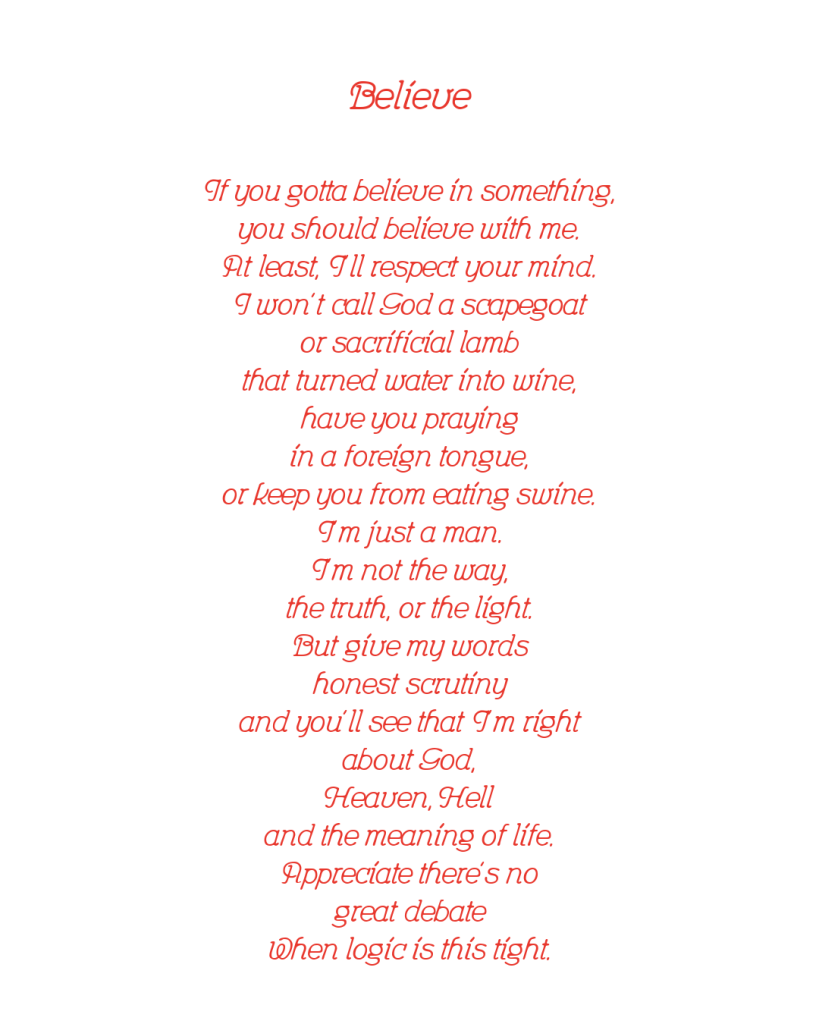
Chapter 10
I am not a Prophet
I am a philosopher who stumbled onto a breakthrough that allows reason to fully enter the field that has shunned use of the intellect altogether, theology. I don’t know if I’m the first to compare zero and God, but I am confident that I am the first to fully explain all that the comparison implies. Even though I believe that comparison most accurately explains what the ancient prophets sought to teach the people of their time, I do not see myself as a prophet nor am I comfortable with any comparison to them.
I have no magical abilities, I can’t see into the future, and I have not been visited by any angels, demons, aliens, or gods. I didn’t need to be visited in order to make my breakthrough and I don’t need to be a magician or fortune teller to convince you of the truth concerning God because we have enough conceptual context to fully grasp the zero principle and apply it to theology.
It isn’t humility or modesty that makes me say I’m no prophet. It’s honesty. I think they are overrated in this day and age. They’re heroes of fantastic tales propped up as glorified role models for righteousness.
First of all, there can be no role model for righteousness because there is no external act linked to worshipping God alone. Furthermore, focusing on their life stories has taken the focus away from the one thing all the true prophets said: God is the creator of all.
If you can anticipate my struggle convincing you or anyone else God is to reality what zero is to math, then you should be able to appreciate any struggle the actual prophets had in convincing the people of their day of the same thing without the aid of zero and math.
Hopefully, you can also see how that message could get distorted over time. Maybe, if the focus would have stayed on their words instead of their works, what I have to say today would be redundant and unnecessary.
When I think of my accomplishment, I am buoyed with a sense of pride. While I believe my message in this day is congruent with the prophet’s in their day, I don’t think I’m the difference maker. The difference is us. Instead of being puffed up with so much pride that I think I’m on their level, I recognize my success makes me less relevant.
It’s not like my breakthrough gives me any added insight as to what is true or false within any of their legacies, including their legitimacy or existence. What I do know is anything that contradicts my oft repeated analogy is false, regardless of the source. Anything that agrees is true. Anything from the past that is neither confirmed as true nor exposed as false from that analogy can be taken as insightful, enlightening, informative, entertaining, or irrelevant when it comes to righteousness.
I would be humbled by just a comparison to any of the noteworthy philosophers or scientists in history. Whether you agree or disagree with those who are still talked about, at least, you are considering their words and feel free to critique what remains of their legacy.
At best, that’s how anything I have to say should be treated: something to be seriously considered but not something to be believed without question. You should believe God is to reality what zero is to math and with God is Heaven and Hell because it is impossible to dispute them without disagreeing with yourself.
For me, it’s a balancing act. On the one hand, because I live in a society that celebrates entertainers, athletes, and politicians over those who perform the tasks necessary for our survival and practical advancement, I do believe my accomplishment ought to be celebrated. On the other hand, I can’t see what I’ve done as special because anyone could have done it. The fact that I am the one who did it when any of us could isn’t lost on me. I’m just not able to fully embrace my role as a messenger because I have no source of information outside of my brain, and my tendencies are too hedonistic to think of myself as holy.
I’m sort of like a lottery winner. There isn’t anything inherently different or special about them that you can say caused them to win, but that prize money spends the same as hard earned cash. If they shared that money with you, how they got it wouldn’t stop you from being grateful. Instead of me winning some dollars, I hit the philosophical jackpot.
If you are benefitting from my victory, not only do I want your affection and goodwill, but I think I’ve earned it with just two phrases: God is to reality what zero is to math and with God is Heaven and Hell. What I don’t want is for anyone to expect me to do the impossible.
Successfully applying logic and reason to theology is as close to a miracle as I have in me. I don’t want anybody blindly believing anything because they believe I said it or following my tastes or tendencies thinking they are a part of righteousness, either.
I’m a pretty smart guy, so I wanna say it’s my superior intellect that allowed me to break through our need for sensory perception and imagination in order to understand God. The problem is there are far too many people smarter than me for me to climb up on that high horse.
I’ve waited for over 20 years for one of you math or science minded geniuses to come along and take this responsibility from me and address the subject academically. Even though I appreciate the potential opportunity to earn more wealth or fame than I would have ever sought for myself, there is a big part of me that can’t stand any of you…especially those of you who will personalize and dissect my words in order to dispute me instead of being grateful that I noticed the concept that makes math possible also makes monotheism reasonable.
One observation I’ve made over the years is: no one actually wants to know the truth about God. It’s not that people have a problem with the truth per se. It’s more like they reject the idea that there is an objective truth about God or the origin of the universe at all. Most people don’t even think the religion they claim to believe is totally true or immune to their personal revisions.
Ears clog and minds close when God comes up in conversation because that part of us that manipulates the mind kicks into high gear as soon as we realize there can be no empirical evidence that could call out any lies. As long as there is no absolute truth, no one can be wrong, so it’s okay if you invent the greatest imaginary friend you’re willing to believe exists or decide for yourself how the universe came to be.
Whether what you believe makes sense to others or not doesn’t matter because you have a right to believe whatever you want, especially when no one can prove you wrong. Such imaginary omnipotence through ignorance is addictive and hard to give up.
I think that’s what makes me different from most people: I want the truth no matter what it is, and the sooner I can get it, the better. Over the years, I’ve developed the tendency of stripping away the superficial eye catchers that distract us from what is essential. I’ve applied this train of thought to other subjects besides theology. I enter this field first because it is the most impactful and has the least room for my bias or personal opinion. At the end of the day, I’m just a thinker whose discovery comes in the form of an analogy instead of an equation: God is to reality what zero is to math.
Chapter 11
The Breakthrough
I can’t get on my high horse, even if I wanted to, if you consider where, how, and why I made my breakthrough. My journey to discovery began while I was out on bond. I returned to the religion of my childhood believing I had gotten myself into trouble in the first place because I strayed away from “the teachings”. Had I not been willing to break the laws of God, I wouldn’t need to be concerned with the laws of men.
With that mentality, I decided to regain my discipline and adhere to very strict dietary and lifestyle guidelines before I was able to focus on theological clarity. What to do was more important than why in those first few months. Even then, I would fall short of following all the rules all the time.
I didn’t dwell on theology or start reading the Bible or Quran until just before my bond was revoked. My goal was to read them both from cover to cover in order to keep anyone else’s interpretation from coloring my understanding or taking any verses out of context. Even though I had been taught that the messages in both had become tainted over the years, I knew not of any source that was more accurate. My struggles in practicing religion as I knew it made me doubt my leaning towards righteousness, but I had no reason to doubt my ability to discern what makes sense and what doesn’t.
I figured belief in God should make sense or there would be no reason to believe and there would be no way to tell the truth from a lie. Not only had I not heard of any religion that made complete sense, but I also had a problem with the idea of blindly believing the words of men simply because they claimed they were the words of God.
Truth should welcome and withstand objective scrutiny, instead of avoiding it. I even had a problem with the theology of my childhood religion because it seemed contradictory. The reintroduction reminded me of why left “the teachings” as a child.
It was a very confusing and conflicting period of my life. I was practicing a religion that I really didn’t believe in while reading books I didn’t fully trust for answers. My confusion deepened as I began to read the books. What really stumped me were the conflicting and contradicting, yet believable, descriptions of God.
On one hand, you read about a Supreme Being who claims responsibility for things being set up the way they are, sort of like a “divine planner”. There is no way to logically prove such a being exists, but if “He” does, it makes sense to fear and revere him…he does have dominion over things we need and are still figuring out.
It also makes sense that he has limitations, can be disobeyed to the point of being surprised, has a rival who thinks he can defeat him, has a vested interest in the success of human beings to the point of jealousy, and would be unseen because “He” refuses to reveal himself, although he supposedly let one prophet see his ass. Then, on the other hand, you have the Creator of all.
To me, it seems both easy and illogical to gravitate towards the Supreme Being for a multitude of reasons. It is easy because we are intellectual creatures who would/should struggle with accepting anyone or anything as superior to us without having a superior intellect, we need our sensory perception in order to learn about reality so much that imagination is our main tool for grasping what we will never perceive, and we can’t imagine what creation must be like, but we can imagine someone making something out of whatever already exists.
What makes believing God is a Supreme Being rather than the creator of all illogical is the reason why we seek and believe there is a God in the first place: everything must have a beginning. It is so fundamental, axiomatic, and obvious that we never question why that is. The truth is we know and believe everything we can witness or imagine must have a beginning because measurement itself must have a beginning, and everything we will ever know about while we live is measurable, unless it has no quantifiable attributes. Only zero and God fit that description.
I didn’t come close to contemplating any connection between the two early on. I was too busy trying to imagine the process of creation in order to understand the Creator. We are taught from such an early age that something can’t come from nothing, so we automatically conclude something must come from something else. The truth is something can only come into existence if it came from Nothing. Everything else is just a recombination of whatever already exists.
My problem was if this Supreme Being is the Creator of the universe, how could “He” have any attributes or qualities that fit or describe what “He” supposedly created. I concluded that God is the Creator of the universe. If there were some being claiming supremacy in the past, he, she, or it is irrelevant when it comes to understanding God unless that being was trying to teach man about the Creator but got deified instead..
Even though I was moving in the right direction at the time, I felt like I went from confused to absolutely befuddled. I believed beyond a shadow of a doubt there was a Creator of the universe with good reason, but any definition and every description ended in contradiction. I needed a religion I could follow that didn’t ask me to sell out my intellect.
Because the Quran did not go into too much detail describing God and I had not been exposed to Hadith yet, I thought orthodox Islam was the way for me. I was not convinced their rites and rituals were the only way to go, but I didn’t see any flaws in them either. I could be content following as long as no one pushed their rituals as the only way or got too detailed in their description of God.
While seeking safety and shelter through religion, I felt even more vulnerable to reverting to using my imagination in defining and describing God. Even as a practicing Muslim, I felt like my belief was on shaky ground. I became mildly obsessed with trying to get my belief on solid ground after I lost a debate with my atheist girlfriend when I tried to make sense of monotheism.
I even started reading other ancient texts looking for theological insight. Unfortunately, all I could find were confirmations on the mystery followed by contradictory explanations. When I read all the fantastic stories, I had a hard time figuring out what was believable. I couldn’t tell the difference between scripture, mythology, or comic book super heroes. While feeling alone spiritually, I made my breakthrough while being left alone literally for three days.
I was placed in isolation for three days while in transit for court. This is different from disciplinary isolation in that I had no access to anything, including books. It was just me and my shadow. Of course, you contemplate a lot of things when you’re alone with no form of entertainment, but it didn’t take long before I started thinking about what I’m willing to believe.
Once I started down that road, my mind never wavered from the subject. It was the most hellish mental exercise full of frustration that I have ever experienced. I mean no disrespect to women and the physical pain of childbirth when I make this comparison, but my experience was the philosophical equivalent of giving birth.
The first day was pretty uneventful. I had started the day in transit and didn’t get settled until sometime late in the afternoon. I probably spent an hour or two contemplating my current situation at the time before my thoughts shifted to more important matters.
Even once I began to think about God in a more “I need answers” manner, I came up with no answers. I simply wrestled and defeated any ideas of a Creator of the universe that is composed of things that are a part of the universe. I even had to confront the contradictory idea of a self-creating deity.
That next day, I dove right back in picking up where I left off. With no answers concerning my theological belief, I switched my thoughts to Heaven and Hell. My mentality then was: whatever we do in the present is for future gain, and the only future promised to all the living is death. While thinking about Heaven and Hell, I couldn’t help but notice the contradictory mentality that must follow someone taking the allegorical descriptions of Heaven literally.
As my frustration starts to mount because all I can do is negate the beliefs I’ve already been exposed to without any fresh ideas, a song from my childhood starts to play in my head. Because I’ve already rejected “the teachings” twice, once as an adolescent and recently with my conversion to Orthodox Islam, the last thing I want to think about is a song stemming from them.
This had to be the worst case of getting a song stuck in your head. As I tried to shut it out, it just got louder and louder:
Heed the call y’all,
it’s easy to tell,
White man’s Heaven is a
Black man’s Hell.
Once I got past the racial aspect of it, I thought of it from a ‘one man’s Heaven is another man’s Hell,’ perspective. From that train of thought, I wondered if Heaven and Hell were the same reality that would be appreciated in very stark opposite directions. I wondered if the so-called Hereafter was actually to be in the presence of God.
Of course, that must be it, but we still can’t describe God in order to know what that must be like. With that thought, I fell asleep frustrated because I was still stuck trying to figure out who or what God was or wasn’t.
On my last day of isolation, I start off thinking about God. As I am shooting down all the contradictory ideas I’ve shot down already, a somewhat new thought occurs to me: there are three dimensions to consider but most of us only focus on two.
I thought about the Trinity. I didn’t think about it in the same way as the Christians. I saw the Father as the only God, the Creator. The Son was all physical or tangible creation and the Holy Spirit was the laws governing the entire universe. Who is this God that we can only experience through what has been created?
I began to think in 3’s. I started thinking about the states of matter: gas, liquid, and solid. Nope, that’s not it. It made me think of atomic structure though: protons, electrons, and neutrons. Nope, but you’re getting warmer. I thought of positive and negative and how we forget about neutral.
As I started to shoot down the idea of God being neutral, because that would be the exact opposite of what we believe about God, the concept of absolute value pops into my head. I start to think of how absolute and neutral both refer to zero but are nowhere near the same. God is absolute…zero is absolute…Shit! What have I just done?!
Chapter 12
Bitter Pill to Swallow
That must be a surprising reaction for someone who has just made the breakthrough he has been diligently seeking, but I thought I had just committed blasphemy against God. Remember the Supreme Being I dismissed as irrelevant in my search for the Creator? Well, I wasn’t dismissing him anymore.
I became extremely afraid that if he existed, he would get me. Unlike regular death, I feared he would send me straight to Hell. I cried. They weren’t even manly tears that I let stream down my face. I blubbered like a cold bitch. My shoulders shook and everything!
You may want to laugh, but I tell you this because if I can make the breakthrough and I was that afraid of my own beliefs, I understand any fear you have in accepting what I’m telling you, even though you can’t refute it.
While I was crying, I prayed. I prayed the traditional Muslim Salat and I prayed in my own words begging God for forgiveness for the arrogance that led to my blasphemy. I also prayed for the guidance and strength to accept the truth if I actually stumbled into it. As I got off my knees, my mind flooded with every mathematical principle that said zero as it appears on the number line is greater than any other value.
Not only had I not committed blasphemy, I just recognized God in the most accurate and complimentary way. Even still, I wasn’t fully convinced. It took months of study, inner dialogue, and debate to fully accept God is to reality what zero is to math. It took years to grasp how to apply the information to my life.
You don’t need to take as long and hesitate though. There is no way I can explain to you how much the isolation and personal responsibility of an original and controversial theological idea can intensify your doubts. Even as I write these words, I wrestle with the notion of sharing a message with the world that is worthy of being called scripture while honestly recognizing no holiness or prophetic qualities within myself.
What allowed me to leave Islam alone and finally share these ideas as an independent philosophy, Intellectual Righteousness, is the constant defeat I suffered whenever I tried to logically and objectively dispute and refute them. You too should recognize in defeat, there is victory and freedom.
It isn’t surprising that you don’t immediately accept the truth the moment it is presented to you. It is a concept so different from what we are accustomed to when dealing with theology that you should want to reject it. Be mindful of what method you employ in your rejection and what you’re admitting to yourself in the process:
In your attempt to refute this ideology, do you focus on the oft repeated phrase, God is to reality what zero is to math, or do you parse over every other word and phrase looking for an opening to cause confusion or feign misunderstanding? Do you seek to understand in which way I use the words in that analogy, or do you use an alternate definition that may be accurate but also irrelevant and out of context as a means of disagreement? Do you confront the analogy head on, or do you skirt around the main point in order to question or dispute something I’ve already admitted not knowing?
I ask these questions because, if you cannot confront Intellectual Righteousness head on, you have already said “uncle”, even if you’re not ready to admit it to yourself.
If you are honestly having difficulty understanding by what definition of zero I am comparing to God, there is no need to personalize the zero principle and dissect my words. You can simply study or review the concept of absolute value and the role zero plays in determining the value of all other numbers. Look at the number line and notice zero isn’t the opposite of anything but is that which both positive and negative must come from.
Your unwillingness to do that will show that you know you can’t objectively dispute what I’ve said. You are seeking to continue an argument you refuse to admit you’ve already lost through confusion because you know objective and honest clarity works against you.
Why fight the truth, anyway? Is there some gain you can get from reality by lying to yourself I’m not understanding? Don’t you know reality doesn’t depend on your acceptance in order for it to be true? It is what it is whether you believe it or not!
What baffles me most are those of you who will become angry with me for telling you the truth about God. You fought, and you lost. Why wallow in defeat when acceptance of the truth puts you on the winning side? Don’t you realize that your anger is caused by your frustration?
You’ve admitted to yourself that you can’t disagree with me and be right at the same time. If you know the truth now, why stay mad? Why not be pleased to be free from the lies that hindered your ability to fully appreciate reality?
Some of you may think that it is hard to accept this truth even though you know you can’t objectively refute it. Yes, it can be difficult but not impossible. You must be willing to take a conceptual step you have never taken before. It is a step you will never have to take on any other subject either.
I would like to call it a leap of faith, but the word faith has become so tainted over the centuries that it could be misleading, especially since I said from the beginning that I could prove the existence of God without it. Before you delude yourself into believing I’ve contradicted myself, let me explain:
I have been critical of applying faith to God because it has become synonymous with hope, and hope should never be used as a means of cognition. I’m no linguistics expert or anything like that but knowing and understanding God is to reality what zero is to math makes me believe that whatever word got translated into what we call faith once meant believing in what makes sense in spite of the inability to perceive or imagine the reality.
Somehow, faith has morphed into believing the ridiculous in order to imagine and believe in something that can’t be true. When I say, take a leap of faith, I’m saying believe what makes sense without the ability to use sensory perception or imagination as a means of confirmation. It will make all you encounter, acquire, and/or experience work to your advantage whether you can immediately see it or not.
Where could your argument begin or from what angle? If you believe there is a creator of the universe, then there is no denying God is to reality what zero is to math. The only way to define the Creator of all is to mentally eliminate the all, which would leave only zero.
If you don’t believe there is a creator of the universe, your belief contradicts reality. The universe must be finite or else measurement on any level would be impossible. There can be no points, segments, intervals, or change within the infinite. There can be an indefinite amount within the indefinite though.
While it is possible to ignore this irrefutable fact, just know your ignorance exposes your anti-God attitude as anti-intellectual, as well. There must be the same Unique, Absolute, and Infinite beginning for all that is finite. In the most objective science and honest language for defining and describing reality, that Source for all else is zero.
How can you argue against the concept of Heaven or Hell being a return to God? Just as no part of the universe has the power to create, none have the power to destroy. The only way for anything, including the physical yet immaterial force that moves our matter, to cease to exist as an individual is to return to that Creator.
If you doubt whether we will be aware of that final moment of individuality, keep in mind that our souls are awareness itself. Without the material universe, there is no need for a mind to know what is going on. I would argue that our awareness of such an event would be heightened rather than lessened.
Even if we will be totally unaware of this final instance of individual existence, the knowledge of the only reality that can fully satisfy every want we should have gives anyone who applies this information to their lives a huge advantage in appreciation of whatever life has to offer.
Academically and theoretically, there is absolutely no room to even begin an argument against Intellectual Righteousness. You don’t have to accept it though. You can ignore everything I’ve said, and your situation will not change. You are free to continue to create hells on earth as you prepare for Hell in reality by worshipping something silly and imaginative or things that can be taken from you just as easily as you can gain them. If you let that sink in, you would apply God is to reality what zero is to math to your life because there is a powerful selfish motivation to quit resisting what you can’t refute.
Don’t make the mistake of waiting for some religious leader, scientist, or mathematician to be able to refute God is to reality what zero is to math. If you hold your breath, you’ll mess around and pass out or die. I assure you: they will either confirm it as true, ignore me and suggest you do the same, or get embarrassed and exposed as false and contradictory if they try to refute it.
They say there are two sides to every story and the truth is somewhere in between. In theology, those two sides have been religion and atheism. The truth is God is to reality what zero is to math.
That and ‘with God is Heaven and Hell’ are the limits of what is irrefutable. I have opinions on how to apply this information, but my ability to figure something out doesn’t necessarily make me an expert on its application. Take your time and truly consider the information I’ve just given you and live your life accordingly.
When you wonder who is this guy that can bring clarity to a subject riddled with confusion for centuries, I am Damond E. Anderson by birth and Hassan the Butterfly by merit. May peace be with you.